Sweet Potatoes: What Portions, Cooking, and Toppings Change
A sweet potato is a useful starch, but its portion and toppings tell you more about the meal than a cooking-method ranking does.
Use sweet potatoes as you would another starchy part of a meal: notice how much you serve and what you add. USDA reference data show different values for baked and boiled sweet potatoes, but those records can’t prove that one cooking method is healthier. A human snack study also doesn’t establish that sweet potatoes control blood sugar.563
Start with the portion you’re actually eating
A half-cup of baked sweet potato flesh, about 100 grams in the USDA reference data, provides about 90 calories, 21 grams of carbohydrate, 3 grams of fiber, and 2 grams of protein. Those are estimates for the flesh without salt or toppings, not numbers for every sweet potato on your plate.5
Portion changes the comparison quickly. At an illustrative 150 grams, the same baked-sweet-potato record works out to about 135 calories and 31 grams of carbohydrate. That isn’t a recommended serving. It’s a way to see why comparing one small potato with a heaped cup of another preparation can mislead you.6
Sweet potatoes contain some protein, but the baked reference portion has only about 2 grams per 100 grams. If you’re making one the center of lunch, adding a protein-containing food changes the meal more than treating the potato itself as the protein source. For example, you might serve it alongside beans or eggs. The nutrient figures describe the potato alone, not that combined meal.5
Baked versus boiled: compare the food, not just the method
USDA lists baked sweet potato flesh at 90 calories, 20.7 grams of carbohydrate, and 3.3 grams of fiber per 100 grams. Its separate record for boiled sweet potato without skin lists 76 calories, 17.7 grams of carbohydrate, and 2.5 grams of fiber per 100 grams.6
Those are useful reference values, but they aren’t a controlled test of baking against boiling. The entries describe different preparations, including a difference in whether skin was present during cooking. You can use them to estimate what you served; you can’t use them to conclude that boiling removes a particular amount of carbohydrate or that baking is automatically the better choice.6
Toppings deserve their own look. In the same USDA data, an illustrative 5-gram addition of olive oil adds about 44 calories; a 5-gram pat of unsalted butter adds about 36. Neither addition supplies carbohydrate or fiber in a meaningful amount. These examples aren’t a reason to skip a topping you enjoy. They show why a plain-potato figure won’t describe a dressed-up potato.6
How does it compare with other potatoes?
There isn’t a single nutrient winner. In a study of five potato types collected in Anqing, China, the red sweet potato sample had the highest carotene content, while the white potato sample had the highest potassium content. The sample labeled purple potato had the highest protein and fiber content. These are findings about those sampled foods, not a like-for-like calorie or carbohydrate comparison of prepared potatoes in a US grocery store.4
For an everyday choice, decide what you want from the meal as well as which potato you like. A plain sweet potato and a potato served with generous additions aren’t equivalent comparisons. Nor does one nutrient, such as carotene, settle which whole meal fits your needs better.46
Nutrient content isn’t a blood-sugar promise
Sweet potatoes supply carbohydrate, which belongs in the picture if you pay attention to blood glucose. Your body breaks down much of the food you eat into glucose; for people with diabetes, keeping blood glucose within an individual target range matters.51
One randomized crossover study tested a roasted sweet potato snack against several other snacks and no snack before dinner. At one snack time, the rise in glucose after dinner was lower with the sweet potato snack than with no snack. But when researchers considered the glucose response across the snack and dinner together, the groups did not differ in total area under the curve. That makes it a study of snack timing and meal context, not proof that sweet potatoes lower blood sugar overall.3
The practical distinction is simple: a nutrient label tells you what’s in a portion; it doesn’t predict your glucose response to an entire meal. If you count carbohydrates as part of an insulin plan, the amount in your portion matters regardless of whether the starch is sweet potato. A 100-gram serving of baked flesh has about 21 grams of carbohydrate in the USDA reference data.25
Pregnancy, postpartum life, and menopause can change what questions you bring to meal planning, but these potato data don’t show a special sweet-potato effect at any of those stages. Choose the portion and the rest of the meal for your circumstances, rather than expecting this one food to manage hormones or weight.
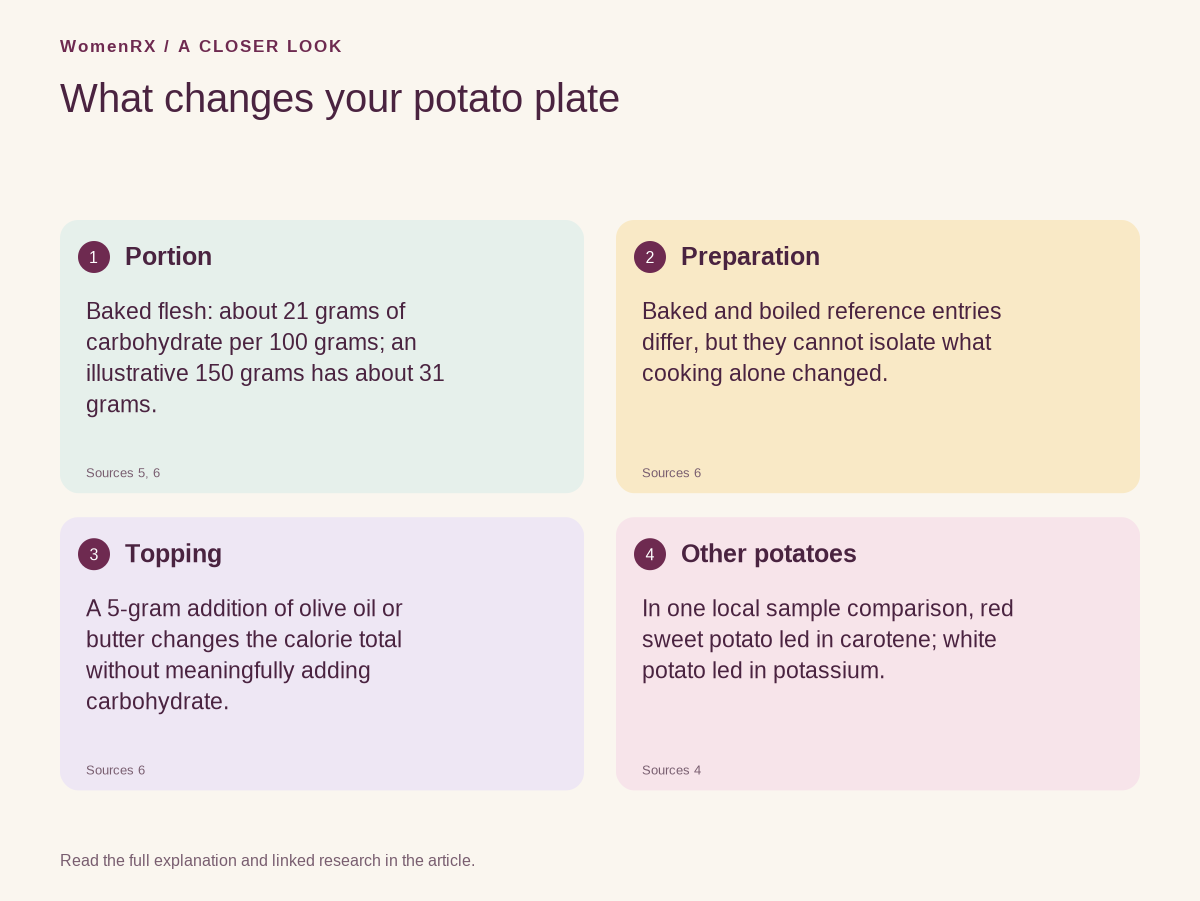
What changes your potato plate
Portion: Baked flesh: about 21 grams of carbohydrate per 100 grams; an illustrative 150 grams has about 31 grams.56
Preparation: Baked and boiled reference entries differ, but they cannot isolate what cooking alone changed.6
Topping: A 5-gram addition of olive oil or butter changes the calorie total without meaningfully adding carbohydrate.6
Other potatoes: In one local sample comparison, red sweet potato led in carotene; white potato led in potassium.4
Read the figure as text
Compare the measured food and portion before drawing a conclusion about the whole meal.- Portion: Baked flesh: about 21 grams of carbohydrate per 100 grams; an illustrative 150 grams has about 31 grams.56
- Preparation: Baked and boiled reference entries differ, but they cannot isolate what cooking alone changed.6
- Topping: A 5-gram addition of olive oil or butter changes the calorie total without meaningfully adding carbohydrate.6
- Other potatoes: In one local sample comparison, red sweet potato led in carotene; white potato led in potassium.4
More questions, answered
Does a roasted sweet potato snack prevent a blood-sugar rise at dinner?
Not as a general rule. In one crossover study, the dinner-only glucose response was lower under some sweet-potato snack conditions, but the total measured response across snack and dinner did not differ between groups.3
Sources you can check
- Blood Glucose | Blood Sugar | Diabetes | MedlinePlusAccessed 2026-09-25Return to first citation
- Insulin for type 1 diabetes - NHSAccessed 2026-09-25Return to first citation
- Effects of intake of four types of snack with different timings on postprandial glucose levels after dinner.Masutomi H, Mineshita Y, Ishihara K, Hirao K, Shibata S, Furutani A. · European journal of nutrition · 2023Return to first citation
- [Nutritional components of 5 potatoes in Anqing City in 2021].Zhang Q, Zhao Z, Yu X, Jiang J, Tian S, Xie J, Liu B. · Wei sheng yan jiu = Journal of hygiene research · 2024Return to first citation
- USDA SR Legacy: Sweet potato, cooked, baked in skin, flesh, without salt (FDC 168483)Accessed 2026-09-25Return to first citation
- USDA SRLegacy: sweet-potato and matched reference-food preparationsAccessed 2026-09-25Return to first citation