Starting Slynd: Bleeding, Backup, and Your First Packs
Spotting is common when you start Slynd, but your start date and pill-taking, not your bleeding pattern, determine whether you need backup contraception.
If you’re not already using hormonal contraception, starting Slynd on the first day of your natural period needs no backup. Start on day 2 or later, and CDC guidance calls for condoms or avoiding sex for the next seven days.23 If you have no periods and aren’t postpartum, CDC guidance calls for seven days of condoms or avoiding sex after starting. After a birth, backup guidance depends on how long it has been, whether you’re breastfeeding, and whether periods have returned.3 Spotting, irregular bleeding, or no bleeding can happen in the first few months, but none tells you whether you’re protected.2
First, separate bleeding from protection
Slynd is a drospirenone-only birth control pill. Each pack has 24 white active pills followed by four green inactive pills. The next pack starts the day after the last green pill, whether or not you’re bleeding.2 Bleeding is something you may notice while taking it, not a test of whether contraception has begun working.
If you aren’t currently using hormonal contraception, Slynd’s patient instructions call for taking the first white pill on the first day of your natural period. Starting on that Day 1 needs no backup contraception. If you start on day 2 or later after your period began, CDC guidance calls for condoms or avoiding sex for the next seven days.23 If you have no periods and aren’t postpartum, CDC guidance calls for condoms or avoiding sex for seven days after starting. Switching from another method and starting after pregnancy have separate considerations; don’t use the appearance of bleeding to guess when you’re covered.23
What bleeding can look like in the first packs
Spotting or bleeding between periods is common when starting Slynd, particularly in the first three months. You might also have less bleeding than expected during the green pills, or none at all. That doesn’t mean every pack will settle into a predictable period.2
The pattern often changes with continued use, but averages can’t predict your next pack. In bleeding diaries from Slynd studies, 1,337 of 2,178 participants with Cycle 1 data (61.4%) reported unscheduled bleeding or spotting. At Cycle 13, 282 of 700 participants with data (40.3%) did. The denominators differ by cycle, and those figures don’t describe an individual user’s trajectory.2 A separate randomized trial in women ages 18 to 45 also found less unscheduled bleeding with a drospirenone-only pill than with a desogestrel-only pill in cycles through Cycle 7. That comparison doesn’t mean bleeding will be regular for every Slynd user.1
An easy distinction to keep in mind: spotting while taking the white pills is a bleeding-pattern question; a late start or missed pills are protection questions. Missing pills can itself cause spotting, so bleeding alone can’t tell you which explanation applies.2
If a pill is missed, the color matters
Slynd’s instructions distinguish the white active pills from the green inactive pills. If you miss one white pill, the patient instructions say to take it when you remember and continue the pack; they say backup contraception isn’t needed for that single missed active pill. If you miss two or more white pills, the instructions call for nonhormonal backup, such as condoms, if you have sex during the seven days after the missed pills. Missed green pills don’t carry that same backup instruction.2
These are missed-pill directions, not a way to decide whether an unusual start date was covered. If a new pack was started late, or you’re unsure which pills you missed, check the product instructions for your exact sequence rather than treating spotting as reassurance.2
Switching methods or starting after pregnancy
The labeled switch date depends on what you were using before. For example, it places the first Slynd pill on the day your next combined-pill pack would have begun, the day your next patch or ring was due, or the day an implant or IUD is removed.2 That calendar date does not, by itself, settle whether you need backup. When additional protection is needed while switching to a drospirenone-only pill, CDC guidance says continuing the previous method for seven days after starting the new pill can be considered.3
An IUD switch needs particular attention if you’ve had sex since your period began and it’s been more than five days since bleeding started. CDC options for addressing sperm that may remain after IUD removal include keeping the IUD in place for at least seven days after starting the pill, or using condoms or avoiding sex for seven days before removal. If neither is possible, its guidance addresses emergency contraception at removal, with different pill-start timing if ulipristal acetate is used. Check those IUD-switch instructions before removal rather than assuming that starting Slynd on removal day covers earlier sex.3
After a birth, time since delivery, breastfeeding, and whether periods have returned can change backup guidance. If you’re not breastfeeding, CDC guidance says no additional protection is needed when starting before day 21 postpartum. From day 21 onward, it calls for seven days of condoms or avoiding sex if periods haven’t returned, or if they have returned and you start on day 2 or later after menstrual bleeding began. The same seven-day conditions apply when breastfeeding, with an exception: someone under six months postpartum who has no periods and is fully or nearly fully breastfeeding needs no additional protection when those criteria are met.3 Those details are why a postpartum start shouldn’t be worked out from a period date alone. If you’ve recently been pregnant, establish which start guidance fits before relying on Slynd.
When a change deserves a closer look
Slynd’s instructions say to check for possible pregnancy if you miss a period after not taking pills as directed, or if you miss two periods in a row despite taking them as directed. Bleeding that persists or begins again after previously regular cycles also deserves assessment rather than automatically being put down to adjustment.2 If you have a positive pregnancy test, stop taking Slynd. Severe abdominal pain when pregnancy is possible needs urgent care because a pregnancy outside the uterus is a medical emergency.2
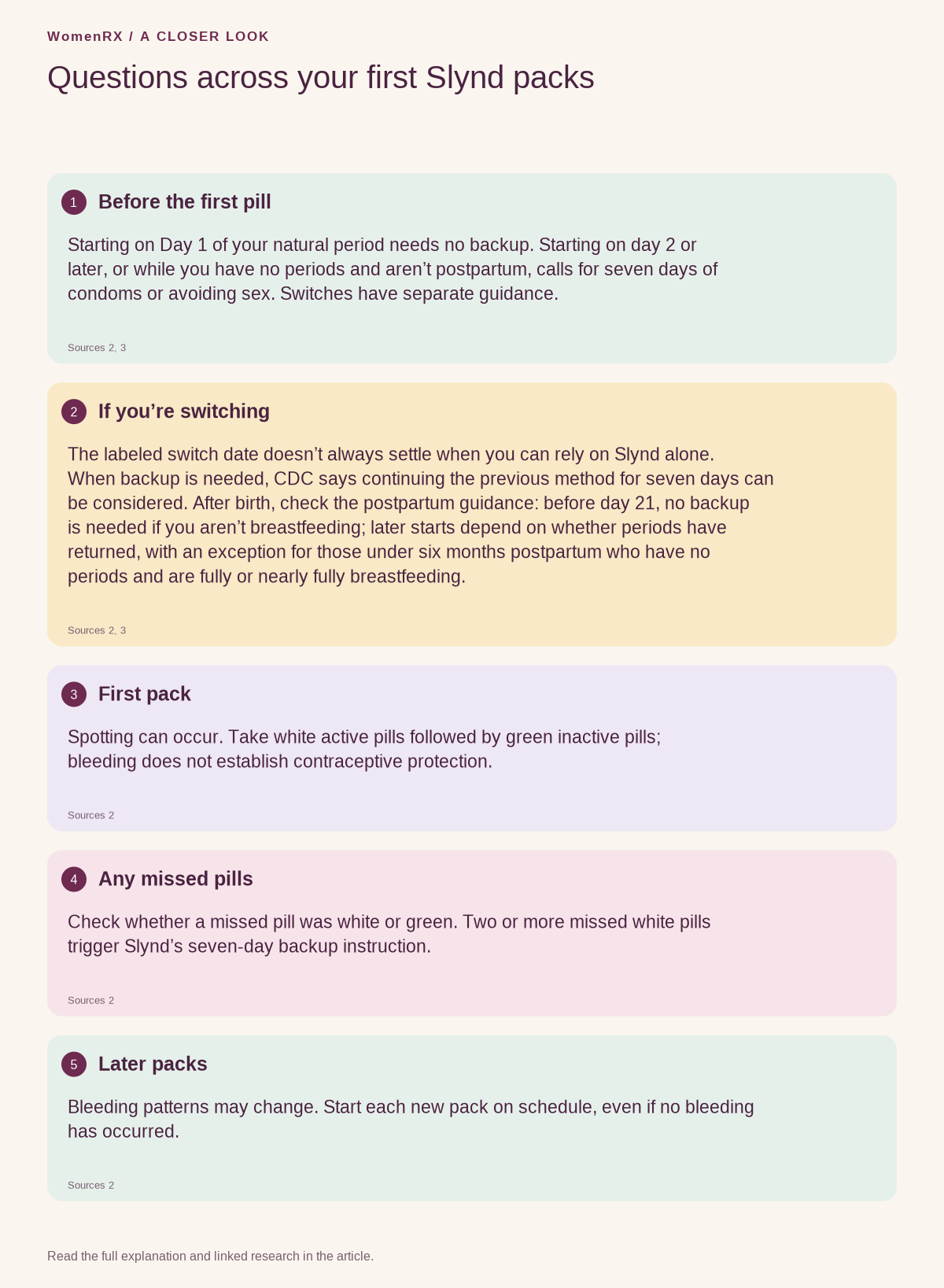
Questions across your first Slynd packs
Before the first pill: Starting on Day 1 of your natural period needs no backup. Starting on day 2 or later, or while you have no periods and aren’t postpartum, calls for seven days of condoms or avoiding sex. Switches have separate guidance.23
If you’re switching: The labeled switch date doesn’t always settle when you can rely on Slynd alone. When backup is needed, CDC says continuing the previous method for seven days can be considered. After birth, check the postpartum guidance: before day 21, no backup is needed if you aren’t breastfeeding; later starts depend on whether periods have returned, with an exception for those under six months postpartum who have no periods and are fully or nearly fully breastfeeding.23
First pack: Spotting can occur. Take white active pills followed by green inactive pills; bleeding does not establish contraceptive protection.2
Any missed pills: Check whether a missed pill was white or green. Two or more missed white pills trigger Slynd’s seven-day backup instruction.2
Later packs: Bleeding patterns may change. Start each new pack on schedule, even if no bleeding has occurred.2
Read the figure as text
A pack-by-pack guide to what determines protection and what bleeding may or may not tell you.- Before the first pill: Starting on Day 1 of your natural period needs no backup. Starting on day 2 or later, or while you have no periods and aren’t postpartum, calls for seven days of condoms or avoiding sex. Switches have separate guidance.23
- If you’re switching: The labeled switch date doesn’t always settle when you can rely on Slynd alone. When backup is needed, CDC says continuing the previous method for seven days can be considered. After birth, check the postpartum guidance: before day 21, no backup is needed if you aren’t breastfeeding; later starts depend on whether periods have returned, with an exception for those under six months postpartum who have no periods and are fully or nearly fully breastfeeding.23
- First pack: Spotting can occur. Take white active pills followed by green inactive pills; bleeding does not establish contraceptive protection.2
- Any missed pills: Check whether a missed pill was white or green. Two or more missed white pills trigger Slynd’s seven-day backup instruction.2
- Later packs: Bleeding patterns may change. Start each new pack on schedule, even if no bleeding has occurred.2
More questions, answered
Should I wait for bleeding before starting the next pack?
No. Slynd’s instructions say to start the next pack the day after the last green pill, whether or not you’re having a period.2
Does spotting mean Slynd isn’t working?
Not by itself. Unscheduled spotting is common, particularly early on, and missed pills can also cause it. Check how you started and whether you missed pills rather than using bleeding to judge protection. If you had no periods before starting and aren’t postpartum, CDC guidance calls for seven days of condoms or avoiding sex.23
Sources you can check
- A multicenter, double-blind, randomized trial on the bleeding profile of a drospirenone-only pill 4 mg over nine cycles in comparison with desogestrel 0.075 mg.Palacios S, Colli E, Regidor PA. · Archives of gynecology and obstetrics · 2019Return to first citation
- SLYND drospirenone tablets, ExeltisAccessed 2026-09-25Return to first citation
- Progestin-Only Pills | Contraception | CDCAccessed 2026-09-26Return to first citation