Planning Psoriasis Treatment Around Pregnancy and Breastfeeding
A treatment review before pregnancy can protect the psoriasis control you need while identifying medicines that may need to change.
If you’re planning pregnancy, pregnant, or breastfeeding, review your exact psoriasis medicines with your dermatologist before stopping or switching them. Discuss what each treatment controls, then consider pregnancy and breastfeeding separately. Methotrexate can cause birth defects; if you become pregnant while taking it, contact your prescriber as soon as possible rather than stopping it on your own. Findings for one biologic cannot establish safety for the whole class.1357

Start with the treatment that’s working now
The most useful starting point isn’t a list of supposedly “pregnancy-safe” psoriasis treatments. It’s your current plan: the names of everything you use, what each treatment controls, and what happens when your psoriasis breaks through. Treatment depends in part on psoriasis type, severity, and where it appears. Patches in a skin fold, for example, may create a different daily problem from widespread patches; recurring joint pain, stiffness, and swelling also deserve attention.1 If you have a few patches and use a treatment applied to the skin, discuss whether it still controls the affected areas and whether that specific product fits pregnancy and breastfeeding. If patches cover large areas or joint symptoms keep returning, discuss what treatment will control those problems and how its pregnancy and breastfeeding evidence differs. Research on both topical and systemic psoriasis treatments during pregnancy and breastfeeding is limited; a treatment’s category alone cannot answer questions about a particular medicine.14
If you’re thinking about pregnancy, make time for that review before changing contraception or treatment. If you’re already pregnant, arrange it now rather than assuming that stopping every medicine is the safest choice. A needed medicine and an untreated condition both belong in the risk-benefit discussion.3
One medicine that calls for an early conversation
Methotrexate is not recommended in pregnancy because it can cause birth defects. If it’s part of your psoriasis treatment, tell your dermatologist when you hope to become pregnant so you can discuss whether to change treatment before stopping contraception. If you become pregnant while taking it, do not stop methotrexate on your own. Contact your prescriber as soon as possible to review what to do next.7
Breastfeeding is a separate decision, not an automatic extension of a pregnancy decision. Methotrexate passes into breast milk in small amounts, and the advice depends on the treatment details and the baby’s circumstances. Discuss it with the clinicians caring for you and your baby rather than applying a general rule about methotrexate to your situation.7
If you already take cyclosporine
If cyclosporine is one of your medicines, bring its name to the review. Discuss what it currently controls and what a change might mean for your symptoms. Ask about that medicine separately before pregnancy, during pregnancy, and while breastfeeding, rather than relying on what is known about methotrexate or biologics.3
What biologic research can, and can’t, tell you
If your psoriasis needs a biologic, the specific drug matters. Certolizumab, an anti-TNF biologic, has pregnancy exposure information that may help inform a discussion. A study of pregnant women receiving certolizumab for approved conditions found a lack of fetal exposure during the third trimester. That finding concerns drug transfer at that stage; it does not, by itself, establish that every pregnancy or infant outcome is risk-free.5
There’s also a small psoriasis-specific report from routine care: among 67 people treated with certolizumab at Spanish hospitals, 14 were treated during pregnancy and/or lactation, with no adverse events reported in those patients or their newborns. The study was retrospective, and the pregnancy and lactation group was small. It offers some reassurance about those reported experiences, not a reliable estimate of uncommon risks or a guarantee for an individual pregnancy.6
Evidence shouldn’t be stretched across the whole biologic category. An analysis of pregnancy safety reports for certolizumab and other anti-TNF medicines found broadly overlapping reported outcomes, but its authors called for more investigation before making firm comparisons. Safety reports cannot tell you how often an outcome occurs among everyone who took a drug.5 If you’re taking a different biologic, ask about evidence for that medicine, rather than assuming certolizumab findings apply to it.
Make a plan for changes in symptoms and feeding
Psoriasis doesn’t follow a dependable script during pregnancy; symptoms can worsen. Talk through what would count as inadequate control for you and how you’d get the plan reassessed if that happens.1 For example, mention if patches begin interfering with sleep or daily activities, or if pain, stiffness, and swelling in your joints keep returning. Recurring joint symptoms warrant assessment rather than simply another skin-treatment change.1
Before breastfeeding, revisit the plan even if your skin is doing well. Some medicines can pass into breast milk, and pregnancy and breastfeeding are different exposure questions.2 Ask about each treatment you actually use, whether it is applied to the skin or taken for more extensive disease, including anything added during pregnancy. For a treatment applied to the skin, or for cyclosporine if you take it, discuss the specific medicine rather than assuming it is safe or unsafe for breastfeeding based on its category. Discuss what treatment could still control your symptoms if psoriasis flares after birth.4 Research on psoriasis treatments during pregnancy and lactation is limited in part because pregnant people are commonly excluded from clinical trials. That makes an individualized plan more useful than a blanket promise that a treatment is safe or unsafe.4
Treatment scope changes the question
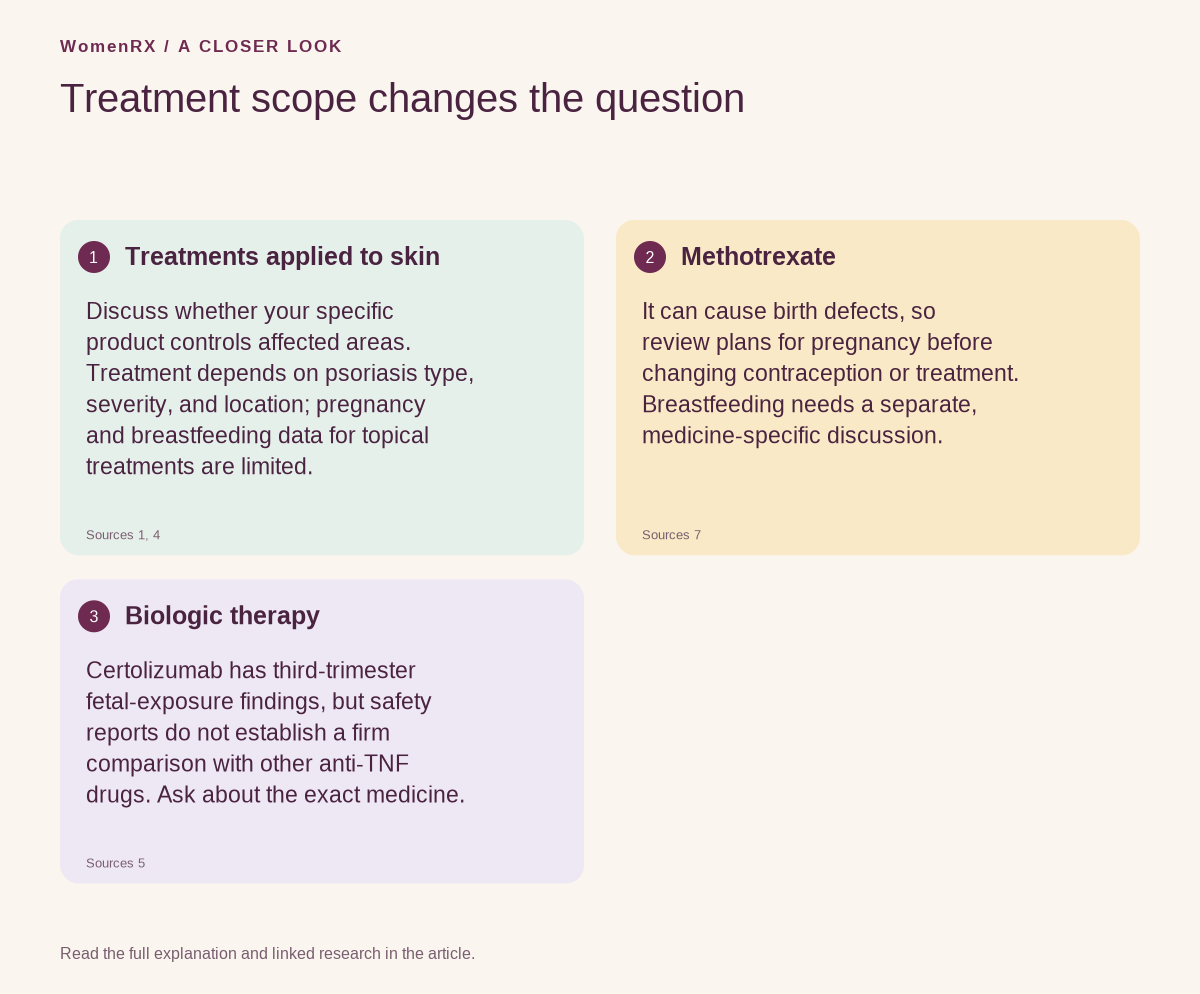
Treatments applied to skin: Discuss whether your specific product controls affected areas. Treatment depends on psoriasis type, severity, and location; pregnancy and breastfeeding data for topical treatments are limited.14
Methotrexate: It can cause birth defects, so review plans for pregnancy before changing contraception or treatment. Breastfeeding needs a separate, medicine-specific discussion.7
Biologic therapy: Certolizumab has third-trimester fetal-exposure findings, but safety reports do not establish a firm comparison with other anti-TNF drugs. Ask about the exact medicine.5
Read the figure as text
Skin extent and joint symptoms affect what treatment needs to control. Pregnancy and breastfeeding evidence must then be considered for the exact treatment, not inferred from its category.- Treatments applied to skin: Discuss whether your specific product controls affected areas. Treatment depends on psoriasis type, severity, and location; pregnancy and breastfeeding data for topical treatments are limited.14
- Methotrexate: It can cause birth defects, so review plans for pregnancy before changing contraception or treatment. Breastfeeding needs a separate, medicine-specific discussion.7
- Biologic therapy: Certolizumab has third-trimester fetal-exposure findings, but safety reports do not establish a firm comparison with other anti-TNF drugs. Ask about the exact medicine.5
More questions, answered
Should I stop my psoriasis medicine as soon as I have a positive pregnancy test?
Don’t make a blanket change on your own. Contact your prescriber promptly to review the exact medicine, how much skin or joint disease it controls, and the risks of leaving those symptoms untreated. If that medicine is methotrexate, do not stop it on your own. Contact your prescriber as soon as possible because it can cause birth defects. Pregnancy findings for certolizumab do not answer safety questions about other biologics or treatments applied to the skin.13457
Sources you can check
- Psoriasis - NHSAccessed 2026-09-25Return to first citation
- Breastfeeding | Benefits of Breastfeeding | MedlinePlusAccessed 2026-09-25Return to first citation
- Pregnancy and Medicines | MedlinePlusAccessed 2026-09-25Return to first citation
- Psoriasis, pregnancy, and lactation: clinical implications and treatments.D'Agostino M, Potestio L, Megna M. · Expert review of clinical immunology · 2025Return to first citation
- Pregnancy Recommendations Solely Based on Preclinical Evidence Should Be Integrated with Real-World Evidence: A Disproportionality Analysis of Certolizumab and Other TNF-Alpha Inhibitors Used in Pregnant Patients with Psoriasis.Gaio M, Vastarella MG, Sullo MG, Scavone C, Riccardi C, Campitiello MR, Sportiello L, Rafaniello C. · Pharmaceuticals (Basel, Switzerland) · 2024Return to first citation
- Certolizumab pegol effectiveness, survival and safety in patients with psoriasis: A multicenter retrospective analysis in daily clinical practice by the Spanish Psoriasis Group.Sahuquillo-Torralba A, Mansilla-Polo M, Pujol-Marco C, Llamas-Velasco M, Rull EV, Ruiz Villaverde R, Ferran M, Pitarch G, Lopez A, Beltran E, Urruticoechea-Arana A, Riera-Monroig J... · International journal of dermatology · 2024Return to first citation
- Pregnancy, breastfeeding and fertility while taking methotrexate - NHSAccessed 2026-09-25Return to first citation