Is Cucumber a Useful Addition to a Weight-Management Meal?
Cucumber can add crunch and volume for few calories, but it works best as one part of a snack or meal, not as a weight-loss strategy on its own.
Yes. Cucumber is a low-calorie vegetable that can add freshness and crunch to a meal or snack. But it has little energy and relatively little fiber, so cucumber alone may not feel substantial. Pair it with foods such as hummus, yogurt, eggs, or chickpeas when you want a more complete option. No cucumber-specific weight-loss effect, including one for women, is established by the findings discussed here. 3
Cucumber can be a useful supporting ingredient: it adds a crisp, refreshing element without contributing much energy. That can suit a snack or meal when you want more vegetables. It isn’t a fat-burning food, though, and eating cucumber by itself doesn’t determine whether your weight changes. 3
What cucumber brings, and what it doesn’t
Cucumber is mostly water and low in calories. The nutritional analysis reported for cucumber and two related vegetables also found little fiber per serving. That makes cucumber an easy ingredient to add, but not a particularly substantial snack on its own. 3
A practical way to use it is to think of cucumber as the crunchy part of a snack, rather than the whole snack. For example, pair cucumber slices with hummus, yogurt dip, or an egg. In a meal, add it to chickpea salad or a grain bowl. These combinations offer more variety than cucumber alone; they don’t make cucumber a weight-loss treatment.
Low-energy-density foods can help, but the evidence is broader
In a small supermarket trial, discounts on low-energy-density fruits and vegetables increased participants’ purchases and intake. The study included 47 adults, 33 of them women, but did not report a separate result for women. Weight change did not differ significantly between the discount and control groups. The study looked at fruits and vegetables as a group, not cucumber specifically, so it doesn’t show that cucumber causes weight loss. 4
That’s the useful distinction: cucumber may fit into a lower-energy meal pattern, but the overall eating pattern matters more than one vegetable. A healthy eating plan needs to supply energy and nutrients, and it can include different foods that fit your preferences and routine. 1 Weight management also involves more than choosing one particular food. 2
Put it to work in a snack or meal
- For a light, crisp snack: eat cucumber with a dip you enjoy. If you want the snack to be more substantial, add a food such as yogurt, hummus, or an egg.
- For a quick lunch: add cucumber to a chickpea salad or grain bowl, alongside other ingredients that make the meal satisfying to you.
- For extra crunch: use cucumber in a sandwich or alongside a meal you already like. It can add texture without needing to replace the rest of the meal.
These are flexible examples, not a required formula. If cucumber leaves you hungry, that’s a sign to add more to the snack, not a reason to expect the vegetable to have a special appetite or metabolism effect.
Is there a special benefit for women?
The findings here don’t establish that cucumber affects weight differently in women. One study of low-energy-density produce included women and men, but reported no women-specific weight result. The cucumber-related clinical study involved only 15 healthy adults and examined short-term responses to different Cucumis vegetables, not weight loss. 34
So choose cucumber because you like it and it helps make a meal enjoyable. If you want a more substantial option, pair it with other foods rather than relying on cucumber alone.
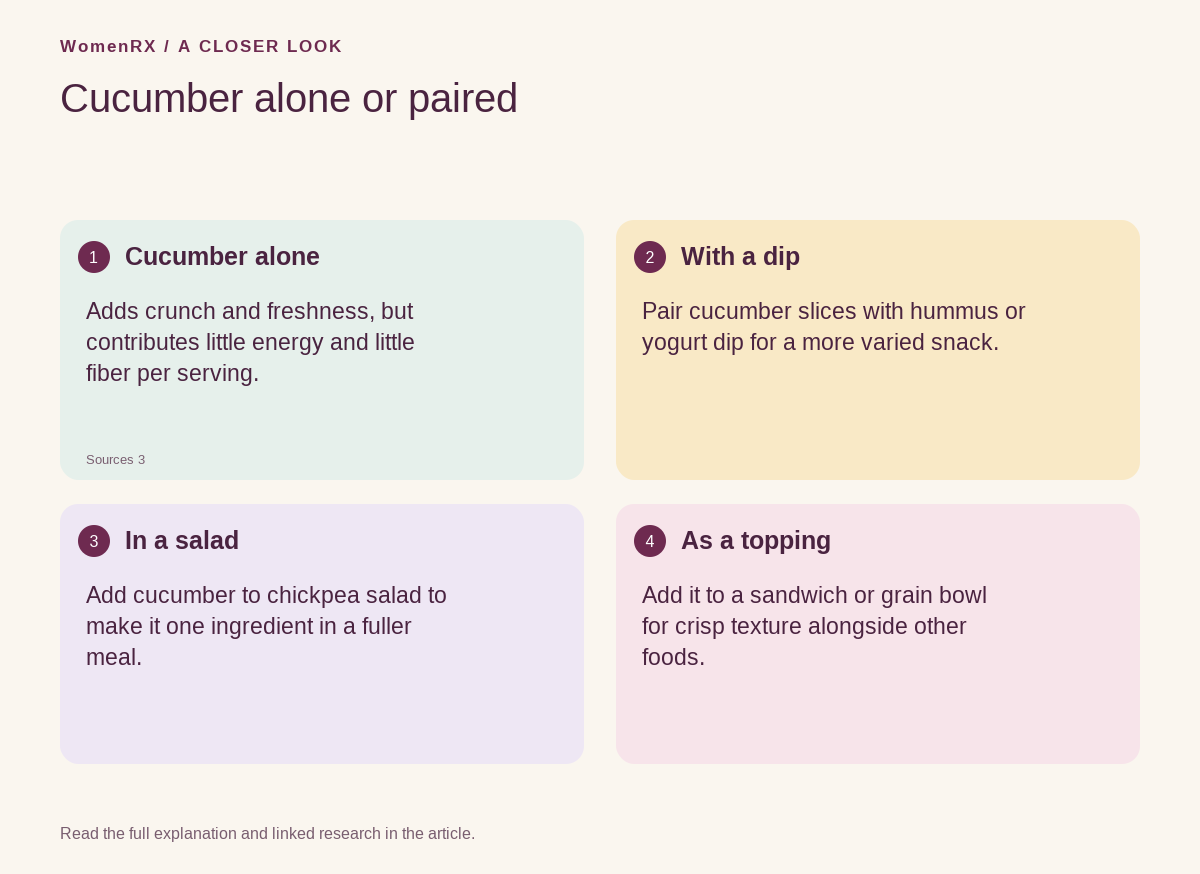
Cucumber alone or paired
Cucumber alone: Adds crunch and freshness, but contributes little energy and little fiber per serving.3
With a dip: Pair cucumber slices with hummus or yogurt dip for a more varied snack.
In a salad: Add cucumber to chickpea salad to make it one ingredient in a fuller meal.
As a topping: Add it to a sandwich or grain bowl for crisp texture alongside other foods.
Read the figure as text
Compare what cucumber contributes on its own with ways to turn it into part of a more substantial snack or meal.- Cucumber alone: Adds crunch and freshness, but contributes little energy and little fiber per serving.3
- With a dip: Pair cucumber slices with hummus or yogurt dip for a more varied snack.
- In a salad: Add cucumber to chickpea salad to make it one ingredient in a fuller meal.
- As a topping: Add it to a sandwich or grain bowl for crisp texture alongside other foods.
Sources you can check
- Nutrition: MedlinePlusAccessed 2026-09-25Return to first citation
- Obesity: MedlinePlusAccessed 2026-09-25Return to first citation
- Two traditional Apulian varieties of Cucumis melo L. exhibit superior sensory and digestive profiles over common cucumber: a population-based and clinical study.Khalil M, Renna M, Pietragalla G, Perniola V, Di Ciaula A, Palmitessa OD, Didonna A, Santamaria P, Portincasa P. · Frontiers in nutrition · 2025Return to first citation
- Supermarket discounts of low-energy density foods: effects on purchasing, food intake, and body weight.Geliebter A, Ang IYH, Bernales-Korins M, Hernandez D, Ochner CN, Ungredda T, Miller R, Kolbe L. · Obesity (Silver Spring, Md.) · 2013Return to first citation