Hyaluronic Acid and Weight: What One Human Trial Actually Found
An arthritis study reported weight changes, but it does not establish a weight-loss benefit for women.
One small trial of an oral supplement containing hyaluronic acid reported a slight average weight loss in the treatment group and a gain with placebo. The difference was statistically uncertain, and the supplement contained other ingredients. It does not establish that hyaluronic acid alone helps weight loss or causes weight gain. 15
The result is more specific than the headline
A study published in Rheumatology International examined Oralvisc, a mixture of hyaluronic acid and other glycosaminoglycans, in people with knee osteoarthritis. Fifty-one people were randomized and 40 completed 12 weeks. Its main questions concerned joint pain and function. 15
The full paper also reported an average 0.55 kg loss with the supplement versus a 0.75 kg gain with placebo, with P = 0.07. That did not meet the usual 0.05 threshold for statistical significance. The completed groups included 20 women, but the paper did not provide a women-specific weight result. 15
This is a reason to describe the finding accurately, not to turn it into a weight-loss promise. A result can be interesting without being dependable enough to guide a purchase.
What this means when you are choosing a bottle
The study leaves three separate questions open: whether the change was a repeatable treatment effect, whether hyaluronic acid contributed to it, and whether the result applies specifically to women. The mixture, small sample and absence of a women-only weight analysis prevent a confident answer. 15
For a weight-loss purchase, those are central questions. A joint product may have another purpose, but that does not turn an uncertain weight finding into a reason to buy it. Ask for evidence about the exact product and the outcome you want, rather than treating any study mentioning hyaluronic acid as a match.
Oral supplements and joint injections are different questions
Research on hyaluronic acid injected into a knee examines a different treatment route. The cited injection review concerns osteoarthritis symptoms, not the weight effects of swallowing a supplement. 8 Likewise, research using hyaluronan in rats with experimental arthritis cannot settle what an oral product does to a woman's weight. 13
Check the methods section or abstract for the route. Words such as “oral” and “intra-articular” tell you whether the treatment matches the product in front of you. Do not let a familiar ingredient name erase that distinction.
If your weight changed after starting a supplement
A change on the scale does not identify its cause. Body weight includes water, muscle, fat and other tissues, and eating patterns, activity, sleep and medicines can all matter. 1
Make a simple timeline of the product, dose, starting date and other changes. Bring the whole ingredient list, including ingredients added for skin, joints or weight management. That makes the question more specific than “Could hyaluronic acid do this?”
If you ask a clinician or pharmacist about the change, bring that timeline and the label. The useful question is whether the whole product, another medicine or a change in your routine could be involved, rather than assigning the cause to one ingredient in advance.
Choose by the outcome that matters to you
If your reason for buying is weight loss, ask for a controlled human study of the exact product that measures weight and reports a convincing result. If the reason is something else, judge that claim separately. A joint, skin or hydration claim should not quietly become a weight-management claim at checkout.
It is reasonable to leave a product on the shelf when its evidence does not answer your question. That is an informed decision, not a missed wellness opportunity.
A weight finding, with its limits
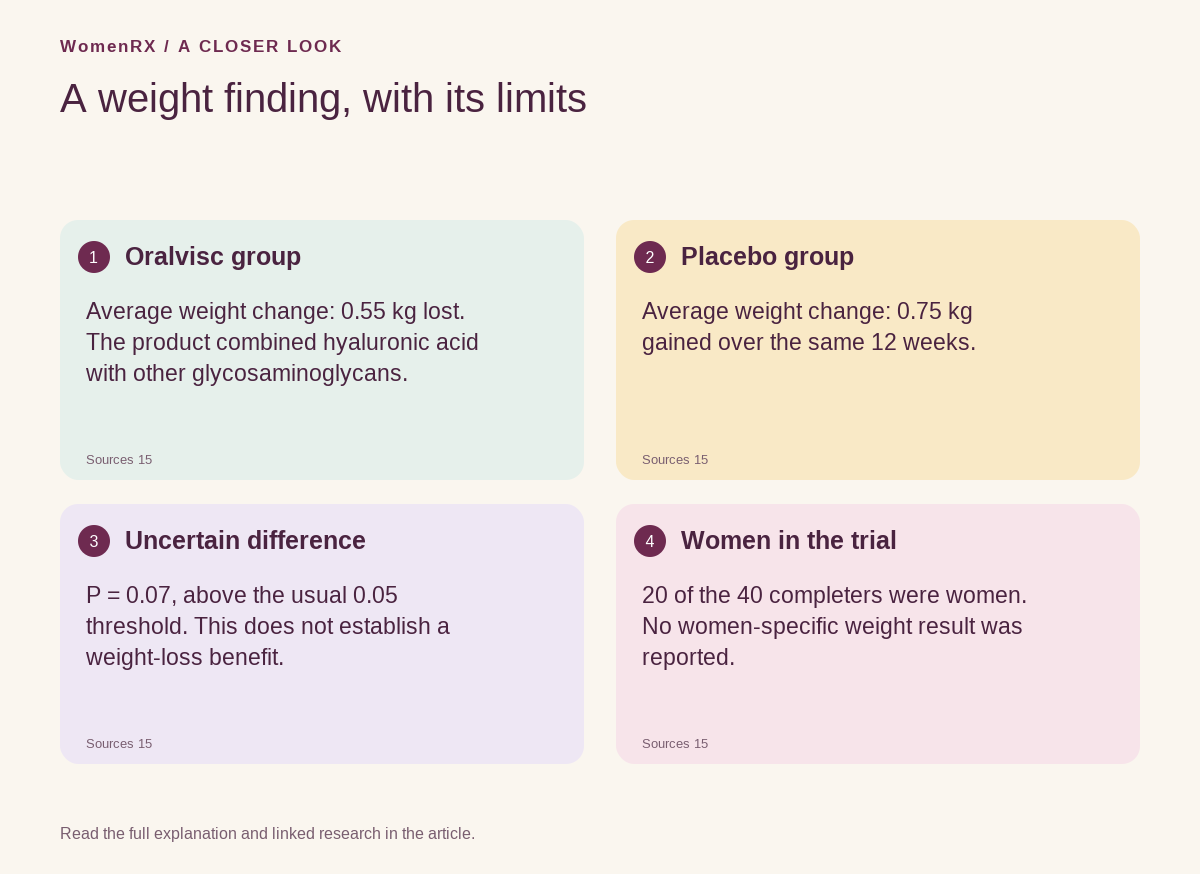
Oralvisc group: Average weight change: 0.55 kg lost. The product combined hyaluronic acid with other glycosaminoglycans.15
Placebo group: Average weight change: 0.75 kg gained over the same 12 weeks.15
Uncertain difference: P = 0.07, above the usual 0.05 threshold. This does not establish a weight-loss benefit.15
Women in the trial: 20 of the 40 completers were women. No women-specific weight result was reported.15
Read the figure as text
Average changes over 12 weeks in a small knee-arthritis trial.- Oralvisc group: Average weight change: 0.55 kg lost. The product combined hyaluronic acid with other glycosaminoglycans.15
- Placebo group: Average weight change: 0.75 kg gained over the same 12 weeks.15
- Uncertain difference: P = 0.07, above the usual 0.05 threshold. This does not establish a weight-loss benefit.15
- Women in the trial: 20 of the 40 completers were women. No women-specific weight result was reported.15
Sources you can check
- Body Weight: MedlinePlusAccessed 2026-09-25Return to first citation
- Quantitative analysis of the efficacy and associated factors of intra-articular hyaluronic acid with respect to osteoarthritis symptoms: A systematic review of randomized trials and model-based meta-analysis.Cao Y, Cai R, Han S, Li Z, Ma K, Zhou Z, Wen X, Qi W, Cen H, Han W, Chen T, Li S, Lin L, Zhu L, Cao Y, Shen C, Fu SN, Bennell K, Hunter DJ, Ding C, Li L, Zhu Z. · Osteoarthritis and cartilage · 2025Return to first citation
- Therapeutic Effects of Two Different Molecular Weights of Orally Administered Hyaluronan, Both as Monotherapy and in Combination with Methotrexate in a Rat Model of Arthritis.Khademnematolahi S, Ponist S, Svik K, Drafi F, Slovak L, Muchova J, Mindang EL, Ahmad W, Bauerova K. · International journal of molecular sciences · 2025Return to first citation
- Nelson et al.: Oralvisc in knee osteoarthritis, full published studyAccessed 2026-09-26Return to first citation