Headache on Zepbound: What the Evidence Can Tell You
Headache isn’t listed among Zepbound’s common trial side effects, but that alone can’t rule out a connection or other causes.
The evidence doesn’t establish headache as a common Zepbound side effect: it didn’t meet the reporting threshold in the drug’s weight-management trial table. A separate analysis in people with type 2 diabetes found no statistically significant increase, but it cannot explain an individual headache. Note the pattern; seek urgent medical advice if headache comes with vomiting, and get medical help right away for a seizure or other immediate warning signs. 1 4 3
What the Zepbound evidence says
Headache can happen while you’re taking Zepbound, but a headache during treatment isn’t proof that the medicine caused it. The distinction matters: clinical trials compare how often events are reported across groups, while an individual headache may have several possible triggers.
In the prescribing information’s pooled weight-management trials, headache wasn’t listed among the adverse reactions that occurred in at least 2% of people taking Zepbound and more often than placebo. That means it didn’t meet the label’s threshold for inclusion in that table. It doesn’t mean no participant had a headache or that a connection is impossible. 1
A 2025 systematic review and meta-analysis of 12 randomized trials, involving 10,615 people with type 2 diabetes, found no statistically significant increase in headache with tirzepatide compared with control groups: the relative risk was 1.00, with a 95% confidence interval from 0.65 to 1.55. The range leaves room for uncertainty; the result isn’t proof that headache risk is exactly the same. And because these trials involved people with type 2 diabetes, they don’t directly answer the question for everyone using Zepbound for weight management. The abstract reports no women-specific headache analysis. 4
A reported headache isn’t the same as a proven side effect
People discuss headache in social media posts about tirzepatide, but those mentions can’t show that the medicine caused the symptom or how often it occurs among all users. Posts don’t provide the controlled comparison needed to separate a drug effect from other explanations. 5
Headaches also have common non-drug triggers. MedlinePlus describes tension headaches as often related to tight muscles and notes that stress, too little sleep, missed meals, and alcohol may play a role. A headache that starts during treatment could have one of these causes, another cause, or possibly a relationship to the medicine. The timing alone can’t tell you which. 2 For someone who menstruates or is going through menopause, a period or menopause may also be relevant: the NHS lists both among common headache causes. This does not show that headache risk from Zepbound differs by sex. 3 4
Zepbound’s trial information lists nausea, diarrhea, and vomiting among common adverse reactions, but the trial information doesn’t establish that these symptoms cause a headache in a particular person. If they occur alongside a headache, record them as part of the pattern rather than assuming an explanation. 1
What to observe, and when to get help
For a mild headache that feels familiar and is improving, note when it began and ended, how it felt, whether it followed a missed meal or poor sleep, whether it coincided with a period or menopause if relevant, and what other symptoms occurred. 2 3 You can also note when your Zepbound dose was taken, without assuming that closeness in time proves causation. A brief record can make a recurring or changing pattern easier to describe.
If the headache keeps returning, is getting worse, or isn’t improving, contact your prescriber or another clinician. Tell them when it began, how it compares with headaches you’ve had before, and whether you’ve had vomiting, diarrhea, or other new symptoms. Guidance on recurring or worsening headaches recommends getting medical advice. 3 If a headache comes with vomiting, seek urgent medical advice rather than waiting to see if it settles. 3
Tell a health care provider if you have a sudden, severe headache. Get medical help right away for a headache after a blow to the head, or one with a stiff neck, fever, confusion, loss of consciousness, or pain in the eye or ear. 2 A seizure with a headache also calls for immediate medical help. 3
The useful takeaway is not to dismiss a headache or automatically blame Zepbound. Compare the symptom pattern with the trial evidence, look for other possible triggers, and use severity and associated symptoms to decide how quickly to seek care.
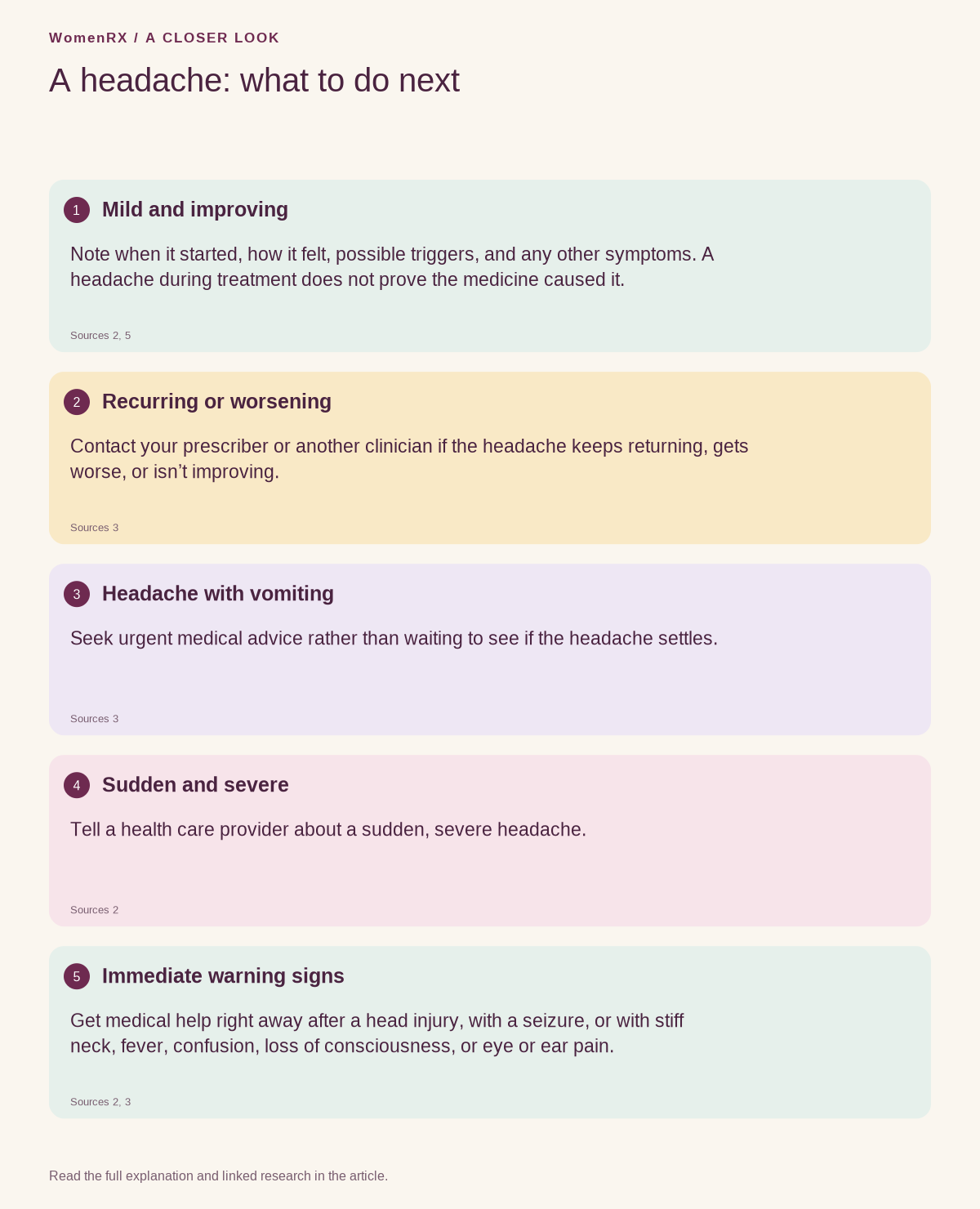
A headache: what to do next
Mild and improving: Note when it started, how it felt, possible triggers, and any other symptoms. A headache during treatment does not prove the medicine caused it.25
Recurring or worsening: Contact your prescriber or another clinician if the headache keeps returning, gets worse, or isn’t improving.3
Headache with vomiting: Seek urgent medical advice rather than waiting to see if the headache settles.3
Sudden and severe: Tell a health care provider about a sudden, severe headache.2
Immediate warning signs: Get medical help right away after a head injury, with a seizure, or with stiff neck, fever, confusion, loss of consciousness, or eye or ear pain.23
Read the figure as text
Use how the headache feels and what comes with it to choose between observing a mild, improving symptom, contacting a clinician, seeking urgent advice, and getting medical help right away.- Mild and improving: Note when it started, how it felt, possible triggers, and any other symptoms. A headache during treatment does not prove the medicine caused it.25
- Recurring or worsening: Contact your prescriber or another clinician if the headache keeps returning, gets worse, or isn’t improving.3
- Headache with vomiting: Seek urgent medical advice rather than waiting to see if the headache settles.3
- Sudden and severe: Tell a health care provider about a sudden, severe headache.2
- Immediate warning signs: Get medical help right away after a head injury, with a seizure, or with stiff neck, fever, confusion, loss of consciousness, or eye or ear pain.23
More questions, answered
Does headache being absent from the common-side-effect table mean Zepbound can’t cause it?
No. The table includes reactions that met a specific frequency and comparison threshold: at least 2% of Zepbound-treated participants and more common than with placebo. Not appearing there doesn’t establish that nobody experienced a headache or rule out a possible connection. 1
Do social media reports show how likely Zepbound is to cause a headache?
No. The study counted headache mentions in posts about tirzepatide, not headache rates among all people taking the medicine. Social media reports can identify experiences people discuss, but they can’t establish that tirzepatide caused those headaches. 5
Sources you can check
- ZEPBOUND (TIRZEPATIDE) INJECTION, SOLUTION ZEPBOUND (TIRZEPATIDE) INJECTION, SOLUTION ZEPBOUND KWIKPEN (TIRZEPATIDE) INJECTION, SOLUTION [ELI LILLY AND COMPANY] | US prescribing information and patient instructionsAccessed 2026-09-25Return to first citation
- Headache | MedlinePlusAccessed 2026-09-25Return to first citation
- Headaches - NHSAccessed 2026-09-25Return to first citation
- Effect of Tirzepatide on arrhythmic, major cardiovascular, and neurological outcomes in patients with type 2 diabetes: A systematic review and meta-analysis.Wu R, Xing B, Zhou Z, Yu L, Wang H. · Neurological sciences : official journal of the Italian Neurological Society and of the Italian Society of Clinical Neurophysiology · 2025Return to first citation
- Harnessing Facebook to Investigate Real-World Mentions of Adverse Events of Glucagon-Like Peptide-1 Receptor Agonist (GLP-1 RA) Medications: Observational Study of Facebook Posts From 2022 to 2024.Alibilli AS, Jain V, Mane H, Yue X, Ratzki-Leewing A, Merchant JS, Criss S, Nguyen QC, McCoy RG, Nguyen TT. · JMIR infodemiology · 2025Return to first citation