Estradiol Spray for Menopause: How to Use It Safely
Estradiol spray delivers hormone through the skin, but where you spray and who touches that skin both matter.
Estradiol spray is a systemic menopause treatment: the hormone passes through your skin into your bloodstream. For the US product Evamist, apply it to the inner forearm as directed, let it dry, and prevent children, other people, and pets from touching the application site. Don’t substitute instructions from a patch or another spray for those that come with your applicator.2
What the spray does
Evamist is an estradiol spray used to reduce moderate to severe hot flashes after menopause. Its solution dries on the skin, while estradiol is delivered into the bloodstream. That makes it a systemic treatment, not a treatment limited to the patch of skin you spray.2
Absorption takes place over time, not just while the skin feels wet. In a study of 72 postmenopausal women using Evamist daily, blood estradiol concentrations appeared to reach a steady state after about seven to eight days. That finding describes hormone levels in a study group; it doesn’t predict when your hot flashes will improve or what your individual level will be.2 A 12-week randomized trial in postmenopausal women found that Evamist reduced the frequency of moderate to severe hot flashes more than placebo at weeks four and 12.2
How Evamist goes on your skin
The instructions below are for Evamist, the US estradiol spray described here. Follow the instructions packaged with your own product and the number of sprays prescribed for you rather than treating every estradiol spray as interchangeable.2
A new Evamist applicator needs to be primed once, with its cover on, before its first use. For an application, the label specifies clean, dry, unbroken skin on the inside of the forearm, between the elbow and wrist. Hold the applicator upright with its cone flat against the skin, then fully press the pump. If your prescribed dose calls for more than one spray, place each additional spray on an adjacent area without overlapping the previous one. Don’t rub the spray in or apply it to your breasts or in or around your vagina.2
Let the site dry for at least two minutes before covering it with clothing, and don’t wash that skin for at least one hour. Evamist contains alcohol, so avoid flames and smoking until it has dried. Sunscreen applied to the site about an hour after Evamist reduced estradiol absorption in a study described in the label. If sunscreen is part of your morning routine, check the product instructions rather than assuming the order doesn’t matter.2
Dry skin can still transfer estrogen
The drying instruction and the contact instruction serve different purposes. Once the spray has dried, cover the site with clothing if someone else may touch it. Don’t let children touch the sprayed area, and don’t let pets touch or lick it. If another person accidentally touches the site, the Evamist instructions say to wash the area of their skin with soap and water right away.2
These precautions have a real reason behind them. Unexpected breast development and breast masses have been reported in children after unintended exposure to Evamist. If a child develops an unexpected breast lump or other sign of sexual development, the product instructions call for prompt medical evaluation and for the person using Evamist to stop using it and contact their prescriber while the cause is assessed. If you can’t reliably keep the application site away from children or pets, discuss another menopause treatment.2
The Evamist instructions focus on keeping the applicator against the forearm and preventing contact with the treated skin; they do not give a separate handwashing step after application. Don’t borrow a handwashing rule from a gel or a different spray and assume it replaces Evamist’s site precautions.2
What to settle before you make it a routine
If you still have a uterus, ask how your prescribed treatment protects its lining. Evamist contains estradiol alone, and its label says a progestogen is generally considered alongside systemic estrogen for a postmenopausal woman with a uterus because unopposed estrogen increases endometrial cancer risk. Report vaginal bleeding after menopause promptly.2
Your own health history also matters more than the convenience of a spray. Evamist’s label lists prior blood clots, stroke or heart attack, certain cancers, liver disease, and unexplained genital bleeding among reasons not to start it. Seek urgent medical attention for warning signs such as sudden changes in speech or vision, or severe chest or leg pain with or without shortness of breath.2
Finally, keep the instructions for your actual applicator handy. Evamist’s patient instructions describe daily use but don’t give a specific missed-dose rule or a handwashing step. If you miss an application or aren’t sure whether a spray went on correctly, ask your pharmacist or prescriber what to do rather than guessing or adding sprays. A patch has its own wear and replacement instructions; those aren’t directions for a spray.21
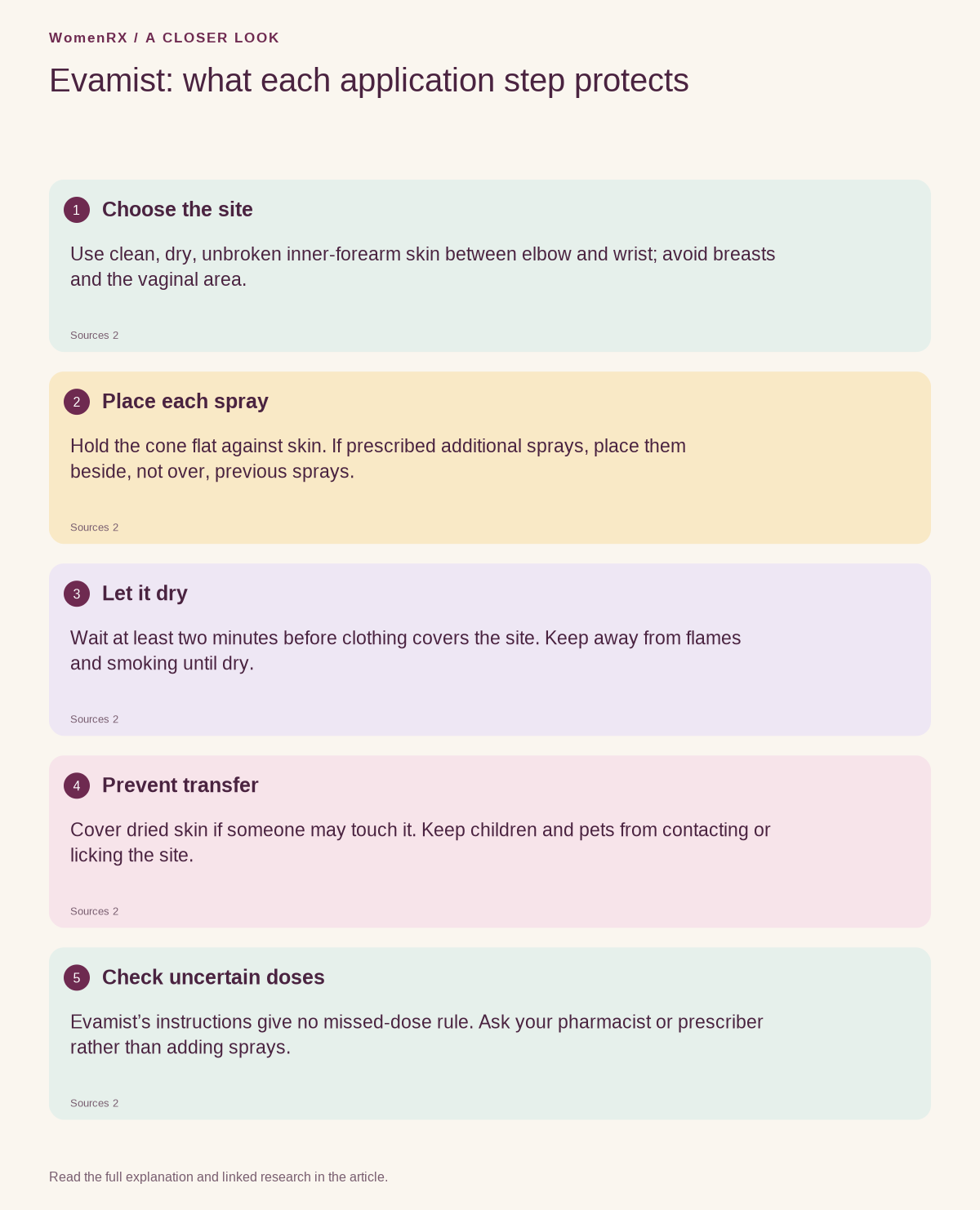
Evamist: what each application step protects
Choose the site: Use clean, dry, unbroken inner-forearm skin between elbow and wrist; avoid breasts and the vaginal area.2
Place each spray: Hold the cone flat against skin. If prescribed additional sprays, place them beside, not over, previous sprays.2
Let it dry: Wait at least two minutes before clothing covers the site. Keep away from flames and smoking until dry.2
Prevent transfer: Cover dried skin if someone may touch it. Keep children and pets from contacting or licking the site.2
Check uncertain doses: Evamist’s instructions give no missed-dose rule. Ask your pharmacist or prescriber rather than adding sprays.2
Read the figure as text
Use this alongside the instructions packaged with Evamist, not as directions for a different estradiol spray.- Choose the site: Use clean, dry, unbroken inner-forearm skin between elbow and wrist; avoid breasts and the vaginal area.2
- Place each spray: Hold the cone flat against skin. If prescribed additional sprays, place them beside, not over, previous sprays.2
- Let it dry: Wait at least two minutes before clothing covers the site. Keep away from flames and smoking until dry.2
- Prevent transfer: Cover dried skin if someone may touch it. Keep children and pets from contacting or licking the site.2
- Check uncertain doses: Evamist’s instructions give no missed-dose rule. Ask your pharmacist or prescriber rather than adding sprays.2
More questions, answered
Does a dry application site mean a child can touch it?
No. Evamist’s instructions say to prevent children from contacting the sprayed skin and to cover it with clothing after it dries if another person might touch it. Drying doesn’t cancel the transfer precaution.2
Is estradiol spray the same as a patch?
Both deliver estradiol through skin, but their routines differ. Evamist is applied daily to the inner forearm; the Climara Pro patch is worn and changed weekly and also contains a progestogen. Use the instructions for the product you were prescribed.21
Sources you can check
- CLIMARA PRO (ESTRADIOL AND LEVONORGESTREL) PATCH [BAYER HEALTHCARE PHARMACEUTICALS INC.] | US prescribing information and patient instructionsAccessed 2026-09-25Return to first citation
- EVAMIST estradiol spray, Padagis | complete current US product informationAccessed 2026-09-25Return to first citation