Does Semaglutide Make Birth Control Less Effective?
Studies have not found reduced exposure to a tested birth control pill with semaglutide, but tirzepatide has a specific precaution for oral contraception.
Semaglutide has not reduced blood exposure to the hormones in a tested combination birth control pill, whether semaglutide was taken by mouth or injection. Those studies measured hormone levels, not pregnancy rates. Tirzepatide is different: Zepbound’s instructions call for a non-oral method or an added barrier method for four weeks after starting it and after each dose increase. 342
If you use birth control and are starting a medicine for diabetes or weight management, check the active ingredient, not just the brand name. Semaglutide and tirzepatide have different evidence and different instructions for oral contraception. There’s also a separate question: what happens to a birth control pill if you vomit after taking it or have diarrhea?
What the semaglutide studies actually tested
Two small studies measured how much of two birth control hormones, ethinylestradiol and levonorgestrel, reached the bloodstream when taken with semaglutide. In a study of 43 postmenopausal women with type 2 diabetes, once-weekly injected semaglutide did not reduce exposure to either hormone in the combination pill tested. Levonorgestrel exposure was higher during semaglutide treatment, while the study’s main conclusion was that neither hormone’s availability decreased. 4
A separate study of 25 healthy postmenopausal women found that oral semaglutide did not meaningfully change blood exposure to either hormone in the combination pill tested. 3
That’s reassuring if your question is whether semaglutide routinely prevents a swallowed pill from being absorbed. But these were hormone-level studies, not studies counting pregnancies. They tested one combination of birth control hormones, and the participants were postmenopausal. The injected-semaglutide study also assessed a particular studied dose, so it shouldn’t be presented as a direct test of every semaglutide regimen or every pill. 34
Why tirzepatide calls for a different plan
Zepbound contains tirzepatide. Its US prescribing information advises people using oral hormonal contraceptives to switch to a non-oral contraceptive method or add a barrier method for four weeks after starting Zepbound and four weeks after each dose increase. It says hormonal contraceptives that aren’t taken by mouth should not be affected by this interaction. This is a tirzepatide-specific instruction, not a precaution to automatically apply to semaglutide. 2
For example, a pill has to pass through the digestive system; a contraceptive patch releases hormones into the bloodstream, while a vaginal ring releases them in the vagina. An implant and hormonal IUD are other non-oral methods. That distinction helps explain which method the Zepbound instruction concerns, but it doesn’t mean you need to change a method that’s already working for you without considering the product instructions and your circumstances. 12
If your prescription says Mounjaro, it also contains tirzepatide. Check the instructions for your specific product with your prescriber or pharmacist rather than borrowing a plan from a semaglutide article. 5
Vomiting or diarrhea is a separate pill question
A medicine can leave pill-hormone exposure unchanged in a study and still cause stomach symptoms in everyday use. Gastrointestinal effects, including vomiting and diarrhea, occur with these medicines, particularly around starting treatment or increasing a dose. 467
If you vomit after swallowing a birth control pill, the immediate question is whether that particular pill stayed down long enough. If you have ongoing diarrhea, the question is whether illness may have interfered with taking or absorbing your pills as intended. The semaglutide interaction studies measured hormone exposure, not pill use during vomiting or diarrhea. 34
There isn’t one vomiting-or-diarrhea instruction that fits every pill and every episode of illness. Use the directions for your exact contraceptive pill to find out whether you need to take any further steps or use backup contraception. If you can’t find those directions or aren’t sure how they apply, ask a pharmacist promptly. This section can point you to the right instructions, but it can’t determine from the interaction studies whether an illness affected your pill.
If you’ve had unprotected sex or a condom broke, ask promptly about emergency contraception. 1
The practical distinction is this: semaglutide itself has not been shown to lower exposure to the tested pill hormones 34; Zepbound has a specific oral-contraceptive precaution 2; and if you vomit or have diarrhea, check your pill’s own instructions, whichever medicine you take.
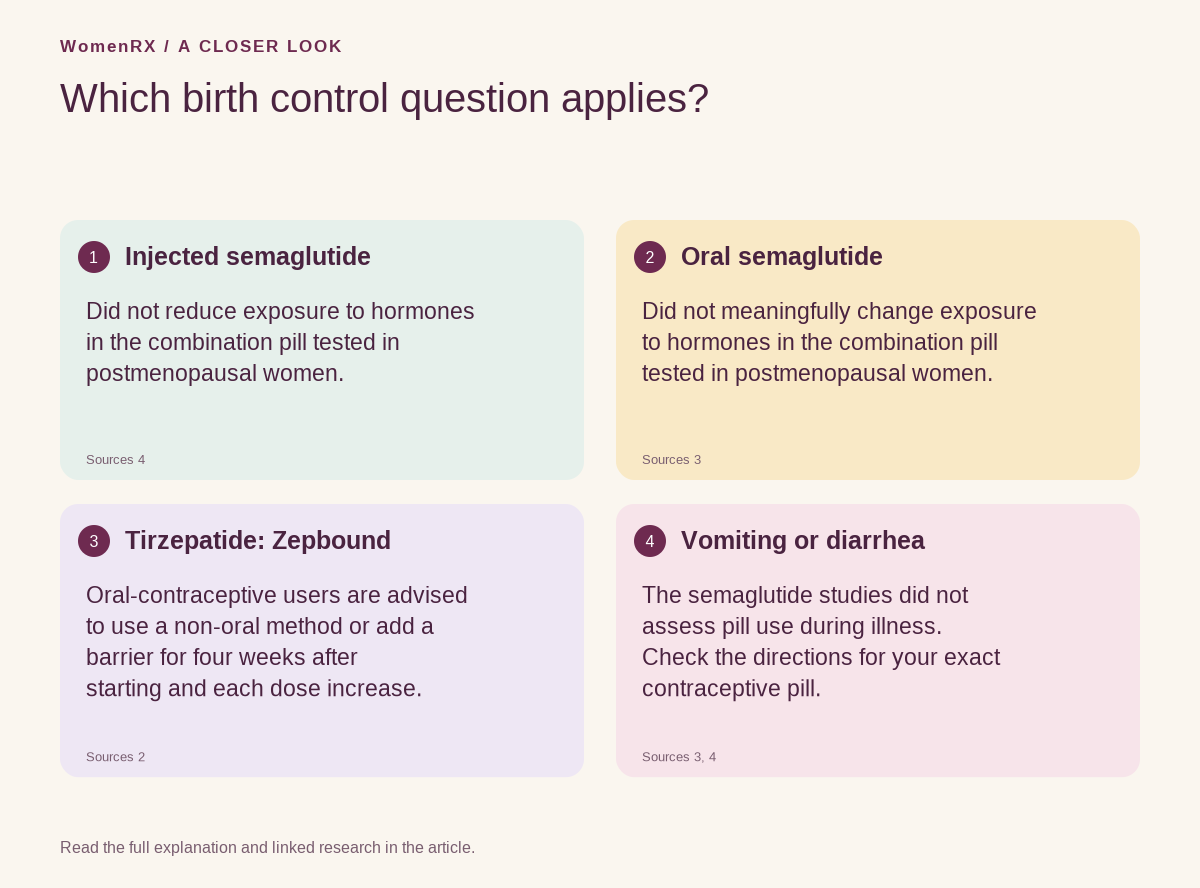
Which birth control question applies?
Injected semaglutide: Did not reduce exposure to hormones in the combination pill tested in postmenopausal women.4
Oral semaglutide: Did not meaningfully change exposure to hormones in the combination pill tested in postmenopausal women.3
Tirzepatide: Zepbound: Oral-contraceptive users are advised to use a non-oral method or add a barrier for four weeks after starting and each dose increase.2
Vomiting or diarrhea: The semaglutide studies did not assess pill use during illness. Check the directions for your exact contraceptive pill.34
Read the figure as text
The medicine-related precaution and a stomach-illness problem call for different checks.- Injected semaglutide: Did not reduce exposure to hormones in the combination pill tested in postmenopausal women.4
- Oral semaglutide: Did not meaningfully change exposure to hormones in the combination pill tested in postmenopausal women.3
- Tirzepatide: Zepbound: Oral-contraceptive users are advised to use a non-oral method or add a barrier for four weeks after starting and each dose increase.2
- Vomiting or diarrhea: The semaglutide studies did not assess pill use during illness. Check the directions for your exact contraceptive pill.34
More questions, answered
Does the tirzepatide precaution apply to an IUD or implant?
Zepbound’s precaution is for oral hormonal contraception. Its prescribing information says hormonal methods that aren’t taken by mouth should not be affected by this interaction. IUDs and implants are non-oral methods. 21
Do the semaglutide studies prove the pill can’t fail?
No. They measured blood exposure to the hormones in one tested combination pill, not pregnancy rates or the effect of every pill formulation. Those studies did not test pill use during vomiting or diarrhea. 34
Sources you can check
- Birth Control | Contraception | Contraceptives | MedlinePlusAccessed 2026-09-25Return to first citation
- ZEPBOUND (TIRZEPATIDE) INJECTION, SOLUTION ZEPBOUND (TIRZEPATIDE) INJECTION, SOLUTION ZEPBOUND KWIKPEN (TIRZEPATIDE) INJECTION, SOLUTION [ELI LILLY AND COMPANY] | US prescribing information and patient instructionsAccessed 2026-09-25Return to first citation
- Effect of Oral Semaglutide on the Pharmacokinetics of Levonorgestrel and Ethinylestradiol in Healthy Postmenopausal Women and Furosemide and Rosuvastatin in Healthy Subjects.Jordy AB, Albayaty M, Breitschaft A, Anderson TW, Christiansen E, Houshmand-Øregaard A, Manigandan E, Bækdal TA. · Clinical pharmacokinetics · 2021Return to first citation
- Semaglutide, a once-weekly human GLP-1 analog, does not reduce the bioavailability of the combined oral contraceptive, ethinylestradiol/levonorgestrel.Kapitza C, Nosek L, Jensen L, Hartvig H, Jensen CB, Flint A. · Journal of clinical pharmacology · 2015Return to first citation
- GLP-1 Receptor Agonists and Fertility: What Is Known So Far?Becker AS, Castilhos JP, Shugair SAS, Colombo T, Hentschke M-. · JBRA assisted reproduction · 2026Return to first citation
- Therapeutic Potential of Anti-Obesity Drugs in Obesity-Associated Female Reproductive Dysfunction: Translating Mechanistic Evidence into Personalized Clinical Strategies.Varra FN, Theodosis-Nobelos P, Varra VK, Varras M. · Medicina (Kaunas, Lithuania) · 2026Return to first citation
- From Weight Loss to Organ-Specific Disease Modification: A Narrative Review of Incretin-Based Therapies in Obesity-Related Cardiometabolic Disease, Chronic Kidney Disease, Metabolic Dysfunction-Associated Steatohepatitis, and Obstructive Sleep Apnoea.Joshi D. · Cureus · 2026Return to first citation