Could You Meet the Medical Criteria for Wegovy?
BMI is a useful starting point for discussing semaglutide, but it can’t decide by itself whether treatment fits your health and goals.
A commonly used starting benchmark for Wegovy weight management is a BMI of 30 or higher, or 27 or higher with at least one weight-related health condition. Those cutoffs appear in semaglutide trial enrollment criteria and a Canadian reimbursement recommendation. 1 4 BMI alone doesn’t establish whether treatment is right for you: a clinician also considers your health history and goals. 2 Bring up pregnancy or breastfeeding plans when discussing the specific product. 3 5
The BMI numbers are a starting point
For adults, the commonly cited BMI benchmarks for semaglutide weight management are 30 or higher, or 27 or higher with at least one weight-related condition. Examples of such conditions include high blood pressure, abnormal cholesterol, type 2 diabetes, and obstructive sleep apnea. These benchmarks appear in semaglutide trial enrollment criteria and are also described in a Canadian reimbursement recommendation. Trial criteria and a reimbursement recommendation do not, by themselves, determine an individual prescribing decision. 1 4
They are a screening starting point, not a diagnosis or a guarantee of a prescription. A BMI of 30 doesn’t, by itself, tell you whether semaglutide is appropriate for your health. And being below a cutoff doesn’t mean your health concerns or weight-management goals don’t deserve attention.
The thresholds described here aren’t stated as different for women and men. But reproductive circumstances can affect the treatment discussion, so pregnancy plans and breastfeeding deserve a specific conversation.
What BMI can, and can’t, tell you
BMI compares weight with height. It can help flag health risk, but it doesn’t distinguish body fat from muscle or bone. It may overestimate body fat in someone with a muscular build, and it can underestimate it in some older adults or people who have lost muscle. A clinician may also consider waist size, since where body fat is carried can add useful context. 2
That’s why two people with the same BMI may have different health histories, needs, and treatment choices. A clinician may review your weight history, earlier attempts to manage weight, activity, current health conditions, and vital signs. Depending on your situation, they may consider blood tests or other evaluation for weight-related health problems. 2
The decision is about more than reaching a number
A useful appointment discussion connects the numbers to what you want treatment to help with. For example, you might want to address a weight-related condition, improve day-to-day function, or find support after previous approaches haven’t met your needs. Share what you hope will change and what has or hasn’t worked for you. Your clinician can discuss whether semaglutide belongs in a broader plan and what goals make sense for your health. Treatment plans can depend on overall weight, other health conditions, and your readiness to participate in a weight-management plan. 2
The product descriptions distinguish their purposes: Ozempic and Rybelsus are described as products for type 2 diabetes, while Wegovy is described for appetite reduction and weight loss. Ask which product and indication your clinician is discussing. 5
A short checklist for your visit
Bring or be ready to discuss:
- Your recent height and weight, if available, and any meaningful changes over time.
- Weight-related conditions you have, such as high blood pressure, abnormal cholesterol, type 2 diabetes, or sleep apnea.
- Medicines and supplements you take, and any health conditions that may affect your weight or treatment choices.
- Approaches you’ve tried and what you’d like treatment to help you do.
- Whether you’re pregnant, breastfeeding, or planning to become pregnant.
Useful questions include: “How are you assessing my health beyond BMI?” “Which semaglutide product are you considering, and for what purpose?” and “How could pregnancy plans or breastfeeding change this discussion?” This gives the appointment a clearer focus than asking only whether your BMI qualifies.
Make pregnancy and breastfeeding part of the decision
If you’re pregnant or considering pregnancy, raise that before starting or continuing treatment. Prescribing information for oral Ozempic and Rybelsus says human data are insufficient to assess drug-related pregnancy risks. Those products aren’t Wegovy, so ask your clinician to review the current information for the product being considered. 3
Breastfeeding evidence for injectable semaglutide is limited. In a small study of milk samples from eight women, semaglutide wasn’t detected, but the researchers noted that questions about longer-term infant outcomes and breast-milk nutrient content remain. That finding is not enough to settle whether treatment is appropriate while breastfeeding. Discuss your circumstances and the product’s current guidance with your clinician. 5
What to take away
The BMI benchmarks can help you decide whether to ask about semaglutide, but they aren’t a verdict. Bring your health history, conditions, goals, and reproductive plans into the conversation so the decision reflects you, not just a calculation.
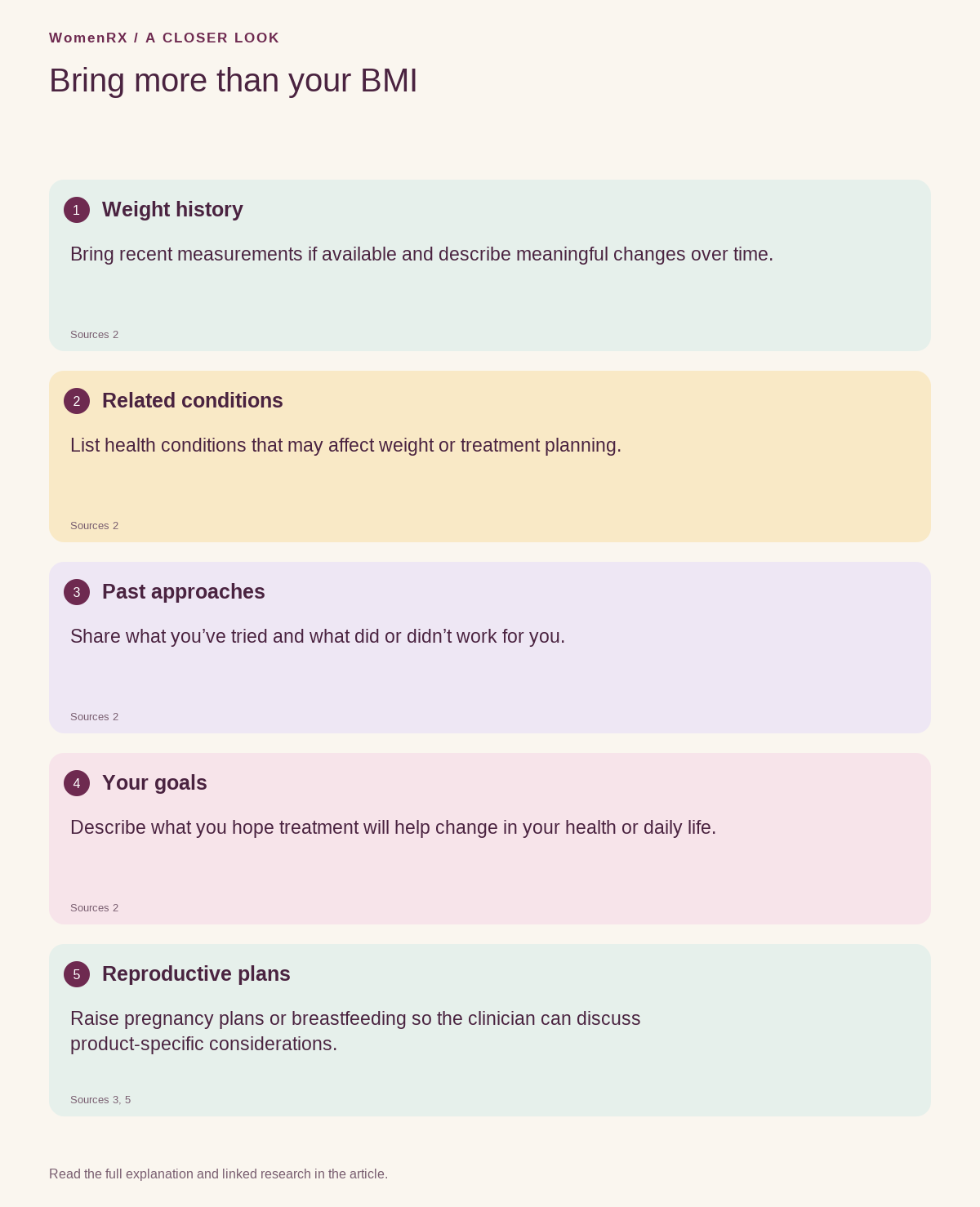
Bring more than your BMI
Weight history: Bring recent measurements if available and describe meaningful changes over time.2
Related conditions: List health conditions that may affect weight or treatment planning.2
Past approaches: Share what you’ve tried and what did or didn’t work for you.2
Your goals: Describe what you hope treatment will help change in your health or daily life.2
Reproductive plans: Raise pregnancy plans or breastfeeding so the clinician can discuss product-specific considerations.35
Read the figure as text
These notes can help make a semaglutide appointment about your health and goals, not just a cutoff.- Weight history: Bring recent measurements if available and describe meaningful changes over time.2
- Related conditions: List health conditions that may affect weight or treatment planning.2
- Past approaches: Share what you’ve tried and what did or didn’t work for you.2
- Your goals: Describe what you hope treatment will help change in your health or daily life.2
- Reproductive plans: Raise pregnancy plans or breastfeeding so the clinician can discuss product-specific considerations.35
More questions, answered
Does a BMI above the benchmark mean I’ll be prescribed Wegovy?
No. The benchmark is a starting point, not a guarantee. Your health history, weight-related conditions, goals, and the clinician’s assessment all matter. BMI also doesn’t distinguish body fat from muscle or bone. 2
Is the breastfeeding research enough to show injectable semaglutide is safe?
No. One small study did not detect semaglutide in milk samples from eight women, but it also identified unanswered questions about longer-term infant outcomes and breast-milk nutrients. It doesn’t settle whether treatment is appropriate while breastfeeding. 5
Sources you can check
- WEGOVY (SEMAGLUTIDE) INJECTION, SOLUTION WEGOVY (SEMAGLUTIDE) TABLET [NOVO NORDISK PHARMACEUTICAL INDUSTRIES, LP] | US prescribing information and patient instructionsAccessed 2026-09-25Return to first citation
- Obesity: MedlinePlusAccessed 2026-09-25Return to first citation
- OZEMPIC (ORAL SEMAGLUTIDE) TABLET RYBELSUS (ORAL SEMAGLUTIDE) TABLET [NOVO NORDISK PHARMACEUTICAL INDUSTRIES, LP] | US prescribing information and patient instructionsAccessed 2026-09-25Return to first citation
- Semaglutide (Wegovy): CADTH Reimbursement Recommendation: Indication: As an adjunct to a reduced calorie diet and increased physical activity for chronic weight management in adult patients with an initial body mass index of 30 kg/m2 or greater (obesity), or 27 kg/m2 or greater (overweight) in the presence of at least 1 weight-related comorbidity such as hypertension, type 2 diabetes mellitus, dyslipidemia, or obstructive sleep apnea2022Return to first citation
- Subcutaneous Semaglutide during Breastfeeding: Infant Safety Regarding Drug Transfer into Human Milk.Diab H, Fuquay T, Datta P, Bickel U, Thompson J, Krutsch K. · Nutrients · 2024Return to first citation