Coffee While Taking Semaglutide: What to Watch
Semaglutide can cause gut symptoms, but its clinical findings don’t show whether coffee is contributing to yours.
Semaglutide can cause nausea and other gastrointestinal symptoms; people also vary in how strongly they feel caffeine’s effects. 1 3 The semaglutide findings cited here don’t establish that coffee worsens those symptoms or changes how the medicine works. You can compare symptoms on days with and without coffee, but a pattern won’t prove the cause. If you take a tablet, check its coffee-timing instructions with a pharmacist.
What the evidence separates
Semaglutide is associated with gastrointestinal effects. In a meta-analysis of trials of oral semaglutide in adults with overweight or obesity, nausea, diarrhea, and vomiting were among the most commonly reported side effects. That finding describes the medicine, not what happens when someone drinks coffee with it. 3
A small pilot study of eight people taking semaglutide also found increased fullness or early satiation while on the medicine. It wasn’t a study of coffee, so it can’t tell us whether coffee changes that feeling. 4
Caffeine has a different set of effects to consider: too much can leave you restless or shaky, and some people are more sensitive to it than others. Those facts don’t establish that caffeine causes semaglutide-related nausea or bowel symptoms. If you feel shaky after coffee and nauseated at other times, noting those as separate experiences may be more useful than calling both a coffee interaction. 1 3
Track the pattern without turning it into a test
If you’re wondering whether to change your coffee habit, make a simple note for a few days of:
- What you drank, including coffee size, caffeinated or decaf, and other caffeine sources
- When you drank it and when you took semaglutide
- What you felt, such as nausea, bowel changes, fullness, restlessness, or shakiness
- Whether symptoms affected eating or drinking, plus meals or other details that help you make sense of the day
This isn’t a validated diagnostic tool. It may show whether a symptom repeatedly follows coffee, also happens without coffee, or has no clear pattern. It cannot show whether coffee and semaglutide interact. If you choose to compare your usual coffee with a smaller serving or a different drink, change one thing at a time so the comparison is easier to interpret.
Caffeine isn’t only in coffee. Tea, cola, energy drinks, and some medicines can add to your intake. An 8-ounce coffee can contain about 95-200 mg of caffeine, and the amount varies. 1
Timing depends on the product
If you use injectable semaglutide, note when you drink coffee and when symptoms start. If you take an oral semaglutide product, the more concrete question for your pharmacist is: Do my tablet’s instructions allow coffee when I take the dose, and when can I have it afterward? Don’t assume advice for an injection applies to a tablet, or that changing coffee timing will solve symptoms.
Bring a pattern you’ve noticed to your prescriber or pharmacist, especially if symptoms keep you from eating or drinking normally. Persistent gastrointestinal problems deserve attention: a review of six published case reports described serious neurological complications after prolonged gastrointestinal symptoms and substantial weight loss. Those case reports do not tell us how often this happens, but they underscore why ongoing symptoms and poor intake shouldn’t be brushed off. 2
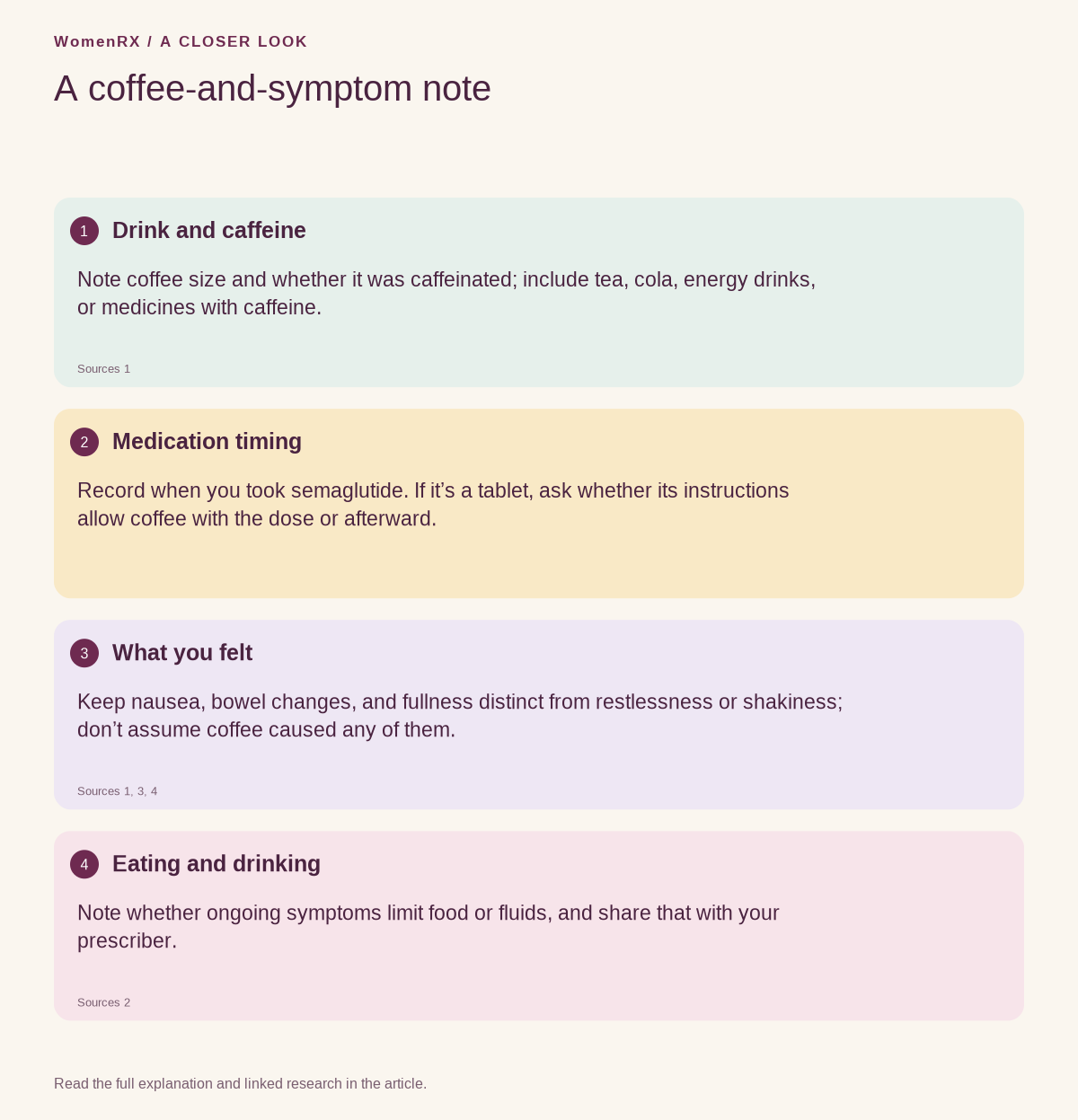
A coffee-and-symptom note
Drink and caffeine: Note coffee size and whether it was caffeinated; include tea, cola, energy drinks, or medicines with caffeine.1
Medication timing: Record when you took semaglutide. If it’s a tablet, ask whether its instructions allow coffee with the dose or afterward.
What you felt: Keep nausea, bowel changes, and fullness distinct from restlessness or shakiness; don’t assume coffee caused any of them.134
Eating and drinking: Note whether ongoing symptoms limit food or fluids, and share that with your prescriber.2
Read the figure as text
Use these details to compare what happens on different days; the checklist cannot identify a drug interaction.- Drink and caffeine: Note coffee size and whether it was caffeinated; include tea, cola, energy drinks, or medicines with caffeine.1
- Medication timing: Record when you took semaglutide. If it’s a tablet, ask whether its instructions allow coffee with the dose or afterward.
- What you felt: Keep nausea, bowel changes, and fullness distinct from restlessness or shakiness; don’t assume coffee caused any of them.134
- Eating and drinking: Note whether ongoing symptoms limit food or fluids, and share that with your prescriber.2
More questions, answered
Should I stop coffee if I feel nauseated?
Not automatically. Notice whether nausea also happens without coffee. A repeated pattern may help you decide whether to change your coffee habit, but it won’t prove coffee caused the nausea. If symptoms persist or interfere with eating or drinking, contact your prescriber rather than relying on a coffee change alone. 2 3
Could another drink be adding more caffeine?
Yes. Tea, cola, and energy drinks contain caffeine; some medicines do too. Check labels and include these sources in your notes so you’re not tracking coffee while overlooking another source. 1
Sources you can check
- Caffeine: MedlinePlusAccessed 2026-09-25Return to first citation
- Wernicke's Encephalopathy Following Semaglutide Treatment for Obesity: A Systematic PRISMA Review of Case-Based Evidence.Bidesie J, Oudman E. · Obesity (Silver Spring, Md.) · 2026Return to first citation
- Effect of oral semaglutide on cardiometabolic risk factors in overweight and obese individuals with or without diabetes: a systematic review and meta-analysis.Seighali N, Gholami-Chahkand MS, Ebrahimzade M, Arashlow FT, Maroufi SP, Rahnama P, Matin MH, Khodayari Javazm A, Ebrahimi P, Nasir K, Thachil R, Sørensen TB, Hosseini K. · BMC pharmacology & toxicology · 2026Return to first citation
- Semaglutide Induces Changes in Gastric Electrical Activity in Patients With Overweight and Obesity: A Pilot Study.Abraham R, Foong D, Piya M, Grudzinskas K, Ho V. · Journal of neurogastroenterology and motility · 2026Return to first citation