Chasteberry for PMS: What to Track Before You Decide
A daily cycle log can show whether symptoms follow a premenstrual pattern, while the research suggests benefits only for certain chasteberry extracts.
If you try chasteberry for premenstrual symptoms, record each day’s symptoms, severity, bleeding, and effect on daily life so you can compare the same details across cycles. A meta-analysis found symptom remission more likely with two specific, characterized extracts than with placebo, but that result doesn’t establish that every product works or how quickly you’ll notice a change. 23
Make the pattern visible
Premenstrual symptoms are easier to assess when you record them throughout the cycle, not only on the hardest days. PMS typically involves recurring physical, emotional, or behavioral symptoms that arise before a period and ease after bleeding begins. Daily records can help show whether that pattern repeats. 3
Keep the log simple enough to use every day. For each symptom, note whether it was absent, mild, moderate, or severe. These are practical labels, not a validated diagnostic score. Include physical symptoms such as breast tenderness, bloating, cramps, or headache, and emotional or cognitive changes such as anxiety, mood shifts, or trouble concentrating. Also note whether a symptom interfered with work, relationships, sleep, or usual activities. 13
Mark the first day of bleeding and note when symptoms start and ease. Record whether you took the supplement that day, which product you used, and any unwanted effects. Keeping the product name matters because studies have tested particular extracts and combinations, not every item sold as chasteberry.
| Part of the cycle | What to record |
|---|---|
| Throughout the cycle | Daily symptom severity and effect on usual activities |
| Before bleeding | Which symptoms appear, and when they begin |
| First day of bleeding | Mark the date as the start of a new cycle |
| After bleeding begins | Note whether symptoms ease and when |
Three cycles of daily records can help show whether symptoms recur in a premenstrual pattern; this is not a proven minimum time to wait for chasteberry to work. The cited studies do not establish an exact or reliable onset of benefit for chasteberry. 123
What the chasteberry evidence actually tested
A 2019 meta-analysis included three double-blind, placebo-controlled randomized trials, with 520 women in total. It found that women taking chasteberry were 2.57 times as likely to experience symptom remission as women taking placebo. The trials tested two specifically characterized extracts, Ze 440 and BNO 1095. That relative comparison does not tell you your personal chance of improvement, and it should not be assumed to apply to a different extract, dose, or blended supplement. 2
The limits matter: of 21 clinical trials considered, only three met the review’s criteria for inclusion. The review noted that many studies had incomplete reporting, particularly about the herbal product used. So the evidence offers a reason to consider certain preparations for PMS, not a guarantee for chasteberry products as a whole. 2
A newer study enrolled 40 women and assessed outcomes over two cycles using a seed-cycling product. One phase included flaxseed and pumpkin seed; another included sesame and sunflower seeds, psyllium, and chasteberry. Participants reported improvements, but the study had no placebo or comparison group. Because several ingredients were combined, it cannot show that chasteberry caused the changes. It also doesn’t establish that seed cycling is equivalent to the characterized extracts in the randomized trials. 12
Use the log to make a fair comparison
Before starting, note your usual symptoms and how much they disrupt your life. Then keep recording in the same way, including days when you feel well. At the end of each cycle, compare the same symptoms and their effect on your activities with your earlier entries. A change in one symptom may matter to you, but don’t treat a single better or worse cycle as proof of a lasting effect.
Write down the exact product name and formulation rather than just “vitex” or “chasteberry.” The trial evidence is preparation-specific, and a multi-ingredient product makes it harder to tell what might explain a change. If the product causes unwanted effects, record what happened and when; tolerability is part of deciding whether it is worth continuing.
If symptoms are severe or regularly disrupt daily life, don’t let a supplement trial become the only plan. PMDD is the more severe, impairing end of the premenstrual symptom spectrum, and treatment options exist beyond chasteberry. 4
Keep fertility and hormone claims separate
The clinical trials summarized here assessed premenstrual symptoms, not whether chasteberry improves fertility or “balances” hormones. A change in a symptom log can help you judge your own experience with that symptom, but it cannot establish a fertility effect or a hormone mechanism. Those are separate claims and aren’t answered by PMS symptom trials. 12
Follow symptoms across your cycle
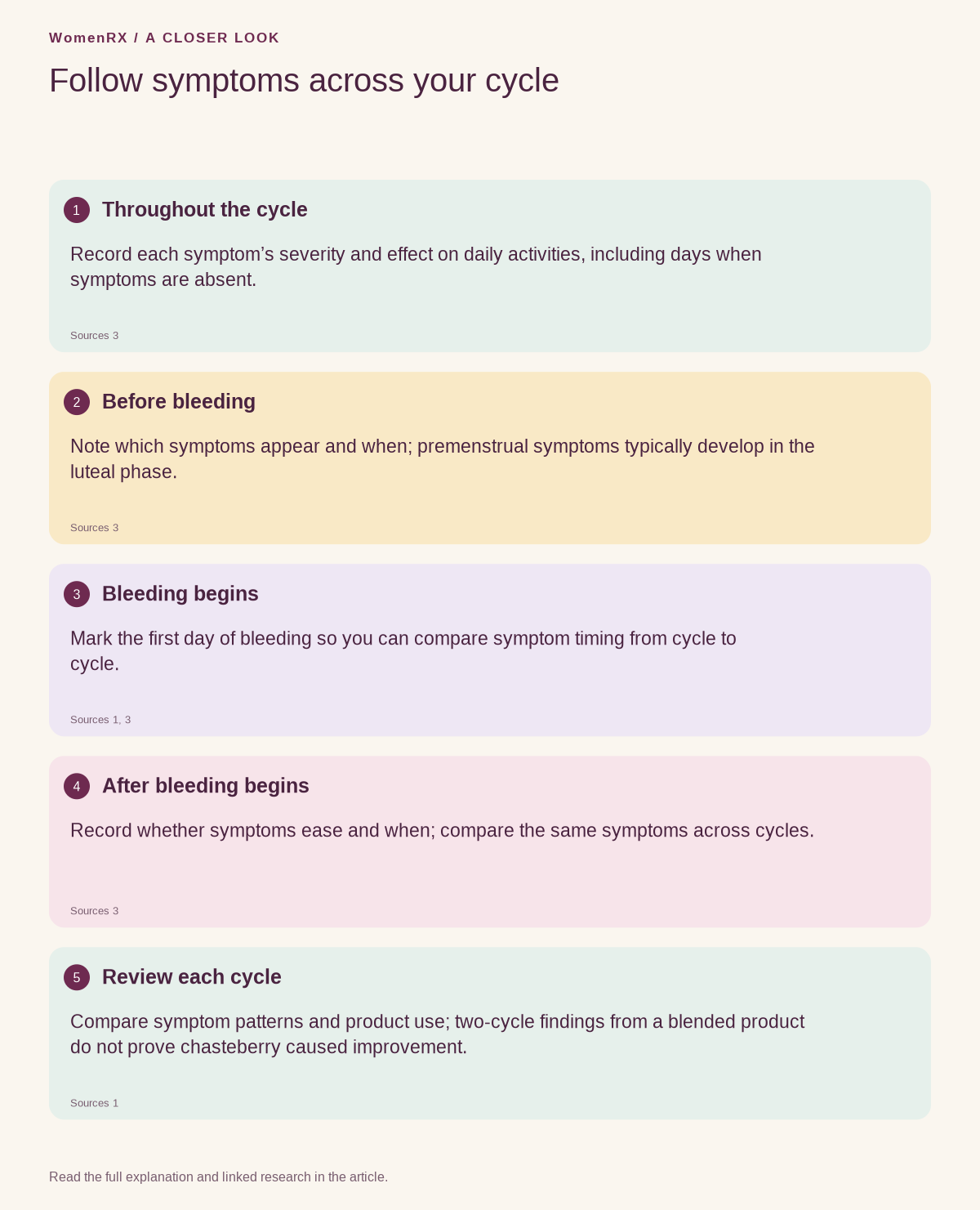
Throughout the cycle: Record each symptom’s severity and effect on daily activities, including days when symptoms are absent.3
Before bleeding: Note which symptoms appear and when; premenstrual symptoms typically develop in the luteal phase.3
Bleeding begins: Mark the first day of bleeding so you can compare symptom timing from cycle to cycle.13
After bleeding begins: Record whether symptoms ease and when; compare the same symptoms across cycles.3
Review each cycle: Compare symptom patterns and product use; two-cycle findings from a blended product do not prove chasteberry caused improvement.1
Read the figure as text
Record symptoms and their impact across the cycle to see whether they recur before bleeding and ease afterward. This timeline is a tracking aid, not a schedule that guarantees when chasteberry should work.- Throughout the cycle: Record each symptom’s severity and effect on daily activities, including days when symptoms are absent.3
- Before bleeding: Note which symptoms appear and when; premenstrual symptoms typically develop in the luteal phase.3
- Bleeding begins: Mark the first day of bleeding so you can compare symptom timing from cycle to cycle.13
- After bleeding begins: Record whether symptoms ease and when; compare the same symptoms across cycles.3
- Review each cycle: Compare symptom patterns and product use; two-cycle findings from a blended product do not prove chasteberry caused improvement.1
More questions, answered
How soon should I expect chasteberry to work?
The cited studies do not establish a reliable time to benefit from chasteberry. A two-cycle study of a combined seed-and-chasteberry product reported changes, but it had no control group and couldn’t isolate chasteberry’s effect. 12
Does evidence for PMS mean chasteberry improves fertility?
No. The trials described here measured premenstrual symptoms, not fertility outcomes. They can’t establish whether chasteberry improves the chance of conception. 12
Sources you can check
- Symptoms of Premenstrual Syndrome in Women Receiving Seed Cycling Capsules With Chasteberry: A Single-Arm Clinical Trial Over Two Cycles.O'Gorman E, Kaunzner UW, Mitschke S. · Cureus · 2026Return to first citation
- Vitex agnus-castus in premenstrual syndrome: A meta-analysis of double-blind randomised controlled trials.Csupor D, Lantos T, Hegyi P, Benkő R, Viola R, Gyöngyi Z, Csécsei P, Tóth B, Vasas A, Márta K, Rostás I, Szentesi A, Matuz M. · Complementary therapies in medicine · 2019Return to first citation
- Premenstrual syndrome: A mini review.Ryu A, Kim TH. · Maturitas · 2015Return to first citation
- Premenstrual Dysphoric Disorder.Lanza di Scalea T, Pearlstein T. · The Medical clinics of North America · 2019Return to first citation