Breastfeeding and Medication: Check the Exact Drug
A useful safety check starts with the exact ingredient, what’s known about it in breast milk, and your infant’s circumstances.
Start with the medicine’s active ingredient, including every ingredient in a combination product. The National Library of Medicine’s LactMed is a breastfeeding resource, but a pharmacist or prescriber can help you weigh what’s known about milk exposure, infant effects, and milk supply against your need for treatment. Bring the product and details about how you use it and your infant’s health. 1 2
Start with the product in your hand
Write down the medicine’s active ingredient, strength, and the amount you take or plan to take. Include how you use it, how often, and whether it’s a combination product. For an over-the-counter medicine, read the Drug Facts label and ask a pharmacist if its instructions aren’t clear. 2
Bring supplements and herbal products into the conversation too. Focus the review on the specific product rather than deciding from a broad label such as “cold medicine” or “pain reliever.” Some medicines can pass into breast milk and cause harm, so a medicine-specific question is more useful than a blanket category. 1
Look up the ingredient, then read beyond a single number
The National Library of Medicine’s LactMed database is a starting resource for breastfeeding questions. Have the active ingredient ready, not just the brand name or the symptom you’re treating. If the product has more than one active ingredient, bring up each one. Keep the package or a photo of its label handy so you and a pharmacist or prescriber can confirm you’re discussing the right medicine. 1 2
Ask three separate questions: Does the drug get into milk? What effects, if any, have been reported in breastfed infants? Is there information about milk supply? Then ask what kind of evidence supports the answer. A measurement in milk tells you about exposure; it doesn’t, by itself, establish what happens to an infant. For example, a cardiovascular-medication review reports measurements of some statins in milk but says studies of their clinical effects in infants have not been done. That distinction matters when you discuss what the finding means for your medicine. 6
If there’s little information, treat that as an unanswered question rather than proof that the medicine is safe or unsafe. Evidence may be sparse for newer medicines, and some medicines have been studied much more than others. A review of lactation-safety assessment describes the difficulty of evaluating drugs when evidence is limited. A systematic review of direct oral anticoagulants found only five eligible studies, involving 12 lactating women and three infants; the reviewers concluded that the evidence was too limited for firm safety conclusions. 4 3
Put the findings in context
When you speak with a pharmacist or prescriber, share your infant’s age and whether your baby was born premature or has a medical condition. Say whether you’re exclusively breastfeeding, combining breast milk with formula, or pumping. Give the exact product, amount, route, and how often you use it, along with other medicines or supplements you take. Your infant’s age and health are especially useful details to volunteer if your baby is very young, was born premature, or has a medical condition. Ask whether those circumstances change the assessment for your specific medicine.
Ask what is known about the medicine getting into milk, possible effects in the infant, and any evidence about milk supply. A small report on brexpiprazole, for example, described three mother-infant pairs. No serious infant events were noted, but the authors raised a possible milk-supply concern. That’s early evidence from a very small group, not a prediction for other families. 7
Your need for treatment belongs in the same discussion. Ask what could happen if you delay or stop it, and whether another option would treat your condition while better fitting your breastfeeding circumstances. For antirheumatic medicines specifically, a survey of 20 rheumatology experts found that decisions about use during breastfeeding often reflected concern about disease activity without treatment. That survey describes expert views in rheumatology, not a rule for every medicine. 5
Before ending the conversation, make sure you know whether the assessment applies to your exact product and how you use it, what remains uncertain for your infant, and who to contact if your baby’s health or your treatment changes. Don’t switch, stop, or skip a prescribed medicine based only on a broad online warning.
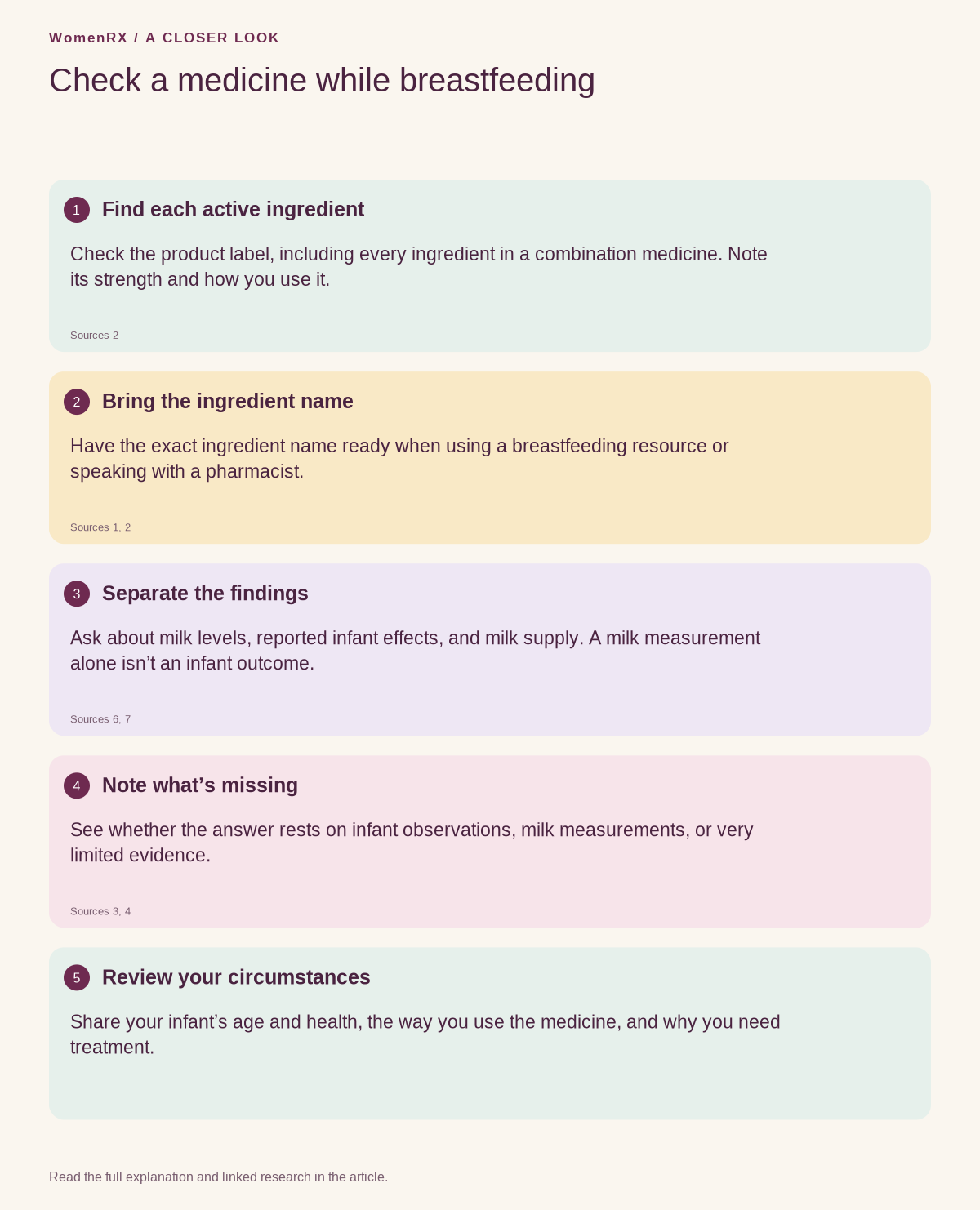
Check a medicine while breastfeeding
Find each active ingredient: Check the product label, including every ingredient in a combination medicine. Note its strength and how you use it.2
Bring the ingredient name: Have the exact ingredient name ready when using a breastfeeding resource or speaking with a pharmacist.12
Separate the findings: Ask about milk levels, reported infant effects, and milk supply. A milk measurement alone isn’t an infant outcome.67
Note what’s missing: See whether the answer rests on infant observations, milk measurements, or very limited evidence.34
Review your circumstances: Share your infant’s age and health, the way you use the medicine, and why you need treatment.
Read the figure as text
Take the product details and separate questions about milk exposure, infant effects, and treatment needs into a medicine-specific conversation.- Find each active ingredient: Check the product label, including every ingredient in a combination medicine. Note its strength and how you use it.2
- Bring the ingredient name: Have the exact ingredient name ready when using a breastfeeding resource or speaking with a pharmacist.12
- Separate the findings: Ask about milk levels, reported infant effects, and milk supply. A milk measurement alone isn’t an infant outcome.67
- Note what’s missing: See whether the answer rests on infant observations, milk measurements, or very limited evidence.34
- Review your circumstances: Share your infant’s age and health, the way you use the medicine, and why you need treatment.
More questions, answered
Should I stop a prescribed medicine as soon as I learn I’m breastfeeding?
Don’t decide from a general warning alone. Ask the prescriber or pharmacist to review the exact medicine alongside the condition it treats. In a survey about antirheumatic medicines, experts considered the risk of disease activity without treatment; that finding doesn’t establish a rule for other medicines. 5
Can I check an over-the-counter medicine myself?
Start with the product’s Drug Facts label and note its active ingredients. Follow the label directions, and ask a pharmacist if the instructions or what the ingredients mean for breastfeeding aren’t clear. 2
Sources you can check
- Breastfeeding | Benefits of Breastfeeding | MedlinePlusAccessed 2026-09-25Return to first citation
- Over-the-Counter Medicines: MedlinePlusAccessed 2026-09-25Return to first citation
- The safety of direct oral anticoagulants use during lactation: A systematic review.Benicio FN, Leite LF, Costa de Almeida LF, Dos Reis Calmon I, Moreno Aguiar S, O'Brien S, Araujo Vieira A, Costa Bueno A. · Thrombosis research · 2026Return to first citation
- Assessing the Safety of Medications During Lactation: Lactation safety.Anderson PO. · The journal of pediatric pharmacology and therapeutics : JPPT : the official journal of PPAG · 2026Return to first citation
- Risk-benefit considerations for antirheumatic drug use in pregnancy, breastfeeding, and male preconception: expert perspectives.Pluma A, Rüegg L, Hamroun S, Cecchi I, Finckh A, Meissner Y, Förger F. · EULAR rheumatology open · 2026Return to first citation
- Lactation safety of cardiovascular medications.Nunez-Pellot C, Akers A, Običan S, Cain MA, Crousillat DR. · American heart journal plus : cardiology research and practice · 2025Return to first citation
- Evaluation of the Safety of Taking Brexpiprazole During the Lactation Period.Fukuda A, Oyanagi G, Kikuchi S, Iwasaki C, Okubo M, Noda A, Morishita K, Okabe N, Iwabuchi R, Sato Y, Kimura E, Kobayashi N, Tomita H, Sato S, Iwama N, Hanita T, Saito M, Tomita H,... · Breastfeeding medicine : the official journal of the Academy of Breastfeeding Medicine · 2026Return to first citation