Will Insurance Cover Vyleesi? What to Ask First
Vyleesi’s labeled use is specific, but only your current health plan can tell you whether it covers the prescription and what rules apply.
There isn’t a single coverage answer for Vyleesi (bremelanotide): benefits and requirements depend on your plan. Its US-labeled use is for premenopausal women with acquired, generalized HSDD that causes marked distress or interpersonal difficulty, and isn’t due to certain other factors. Ask your plan about Vyleesi’s formulary status, any approval requirements, and your expected cost; ask your prescriber whether the indication fits your situation. 1 2

Two separate questions: clinical fit and coverage
A prescription can fit a medication’s labeled use without guaranteeing that an insurance plan will pay for it. Vyleesi’s prescribing information describes who the medicine is indicated for; it doesn’t say which plans cover it or what their requirements are. Insurance is a contract, so the answer to what your plan pays depends on the details of your policy. 1 2
When you contact your plan, ask about Vyleesi by name and, if useful, its generic name, bremelanotide. Don’t assume that a general answer about treatment for low desire applies to this specific prescription.
What the labeled use means
Vyleesi is indicated for premenopausal women with acquired, generalized hypoactive sexual desire disorder (HSDD). “Acquired” means low desire developed after a period without that problem. “Generalized” means it occurs across situations, partners, and types of stimulation. The low desire must cause marked distress or interpersonal difficulty. 1
The prescribing information says the HSDD must not be due to a medical or mental health problem, relationship problems, or medicine or other drug use. These factors can matter when a prescriber is working out what may be affecting desire; they don’t make the concern less real. Health conditions and medicines can affect sexual health more broadly, too. 1 3
Vyleesi is not indicated for HSDD in postmenopausal women or men, and it isn’t indicated to enhance sexual performance. Low desire alone doesn’t establish that the labeled indication fits. 1
Ask your plan for its current, specific rules
Call the member-services number on your insurance card or contact the plan’s pharmacy-benefit administrator. Ask:
- Is Vyleesi listed on my current plan formulary? If not, is it excluded, or is there a way to request coverage?
- Is the prescription covered under my pharmacy benefit or another part of my plan?
- Does my plan require prior authorization, step therapy, or another review? If so, what are the exact criteria?
- Are there quantity limits or restrictions on which pharmacy I can use?
- What would I pay under my current benefits, including any deductible or copay?
- Where can I find the current written benefit terms, and can you explain any answer that’s unclear?
These are questions to verify, not rules that apply to every plan. If the plan says no, ask for the specific reason and what review or appeal options are available under your policy. The plan can explain its own process; the drug’s label alone can’t answer these coverage questions.
Ask your prescriber about the diagnosis, too
You can ask whether your experience fits the labeled description, including whether the change is acquired and generalized, whether it causes marked distress or interpersonal difficulty, and whether other factors may be contributing. If your plan asks for clinical information, ask what documentation it requires and whether your prescriber can provide it. A diagnosis or discussion about low desire does not, by itself, establish that your plan will cover Vyleesi. 1
Before ending the calls, write down the plan’s answer, any criteria or forms it mentions, and who will take the next step. That gives you a practical way to keep the clinical question and the insurance decision distinct.
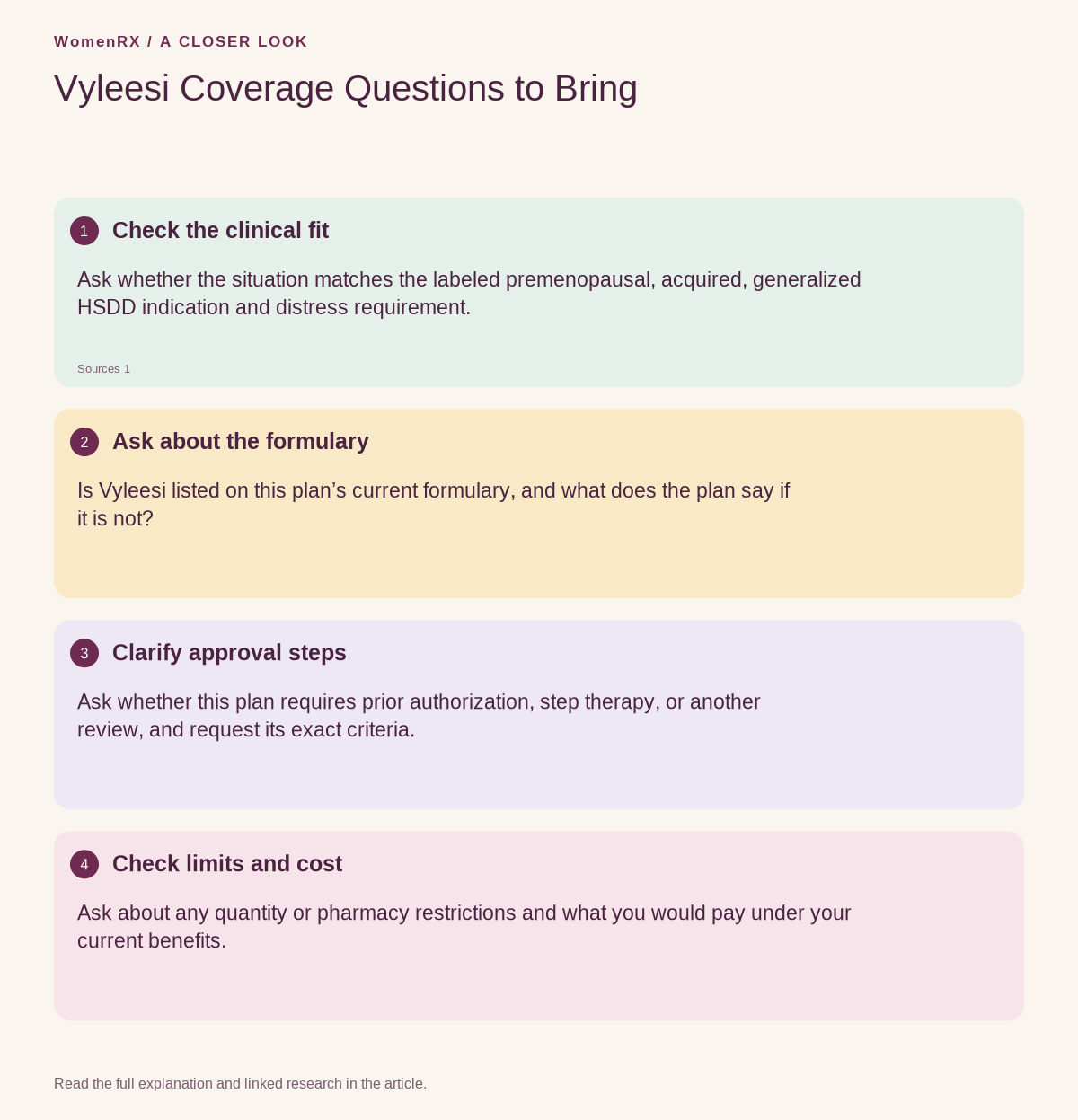
Vyleesi Coverage Questions to Bring
Check the clinical fit: Ask whether the situation matches the labeled premenopausal, acquired, generalized HSDD indication and distress requirement.1
Ask about the formulary: Is Vyleesi listed on this plan’s current formulary, and what does the plan say if it is not?
Clarify approval steps: Ask whether this plan requires prior authorization, step therapy, or another review, and request its exact criteria.
Check limits and cost: Ask about any quantity or pharmacy restrictions and what you would pay under your current benefits.
Read the figure as text
Keep the clinical question separate from the plan’s decision: confirm the labeled-use fit with your prescriber, then ask your plan for its current terms.- Check the clinical fit: Ask whether the situation matches the labeled premenopausal, acquired, generalized HSDD indication and distress requirement.1
- Ask about the formulary: Is Vyleesi listed on this plan’s current formulary, and what does the plan say if it is not?
- Clarify approval steps: Ask whether this plan requires prior authorization, step therapy, or another review, and request its exact criteria.
- Check limits and cost: Ask about any quantity or pharmacy restrictions and what you would pay under your current benefits.
More questions, answered
Does an HSDD diagnosis guarantee coverage?
No. The diagnosis and the labeled indication address clinical fit; your plan’s benefit terms determine whether it covers Vyleesi and whether it requires additional review. Ask your plan for its current rules. 1 2
Is Vyleesi indicated for low desire after menopause?
No. The prescribing information says Vyleesi is not indicated for HSDD in postmenopausal women. Ask your prescriber what options may fit your circumstances. 1
Sources you can check
- VYLEESI (BREMELANOTIDE) INJECTION [COSETTE PHARMACEUTICALS, INC.] | US prescribing information and patient instructionsAccessed 2026-09-25Return to first citation
- Health Insurance: MedlinePlusAccessed 2026-09-25Return to first citation
- Sexual Health | MedlinePlusAccessed 2026-09-25Return to first citation