Will Insurance Cover Testosterone for You?
Your plan’s answer depends on the proposed reason for treatment, the exact product, and how the care is billed.
Maybe, but “testosterone is covered” isn’t a complete answer. Ask your plan about the diagnosis your clinician intends to use and the exact product they’re considering. Then check for prior authorization, preferred-product requirements, and costs for the medication and any separate visits or procedures. Coverage has differed among products in published reports, so your plan must confirm the details. 1 2 3

Start with the reason for treatment
Ask your clinician what they’re proposing testosterone to treat. Use that description when you call your insurer, along with the diagnosis the prescriber expects to submit. Your question is: “Does my plan cover this specific product for this diagnosis, and what requirements apply?” Health insurance pays according to the terms of your plan, not a general rule about a drug’s name. 1
The distinction matters because testosterone is considered in different situations. A review of oral products discusses treatment for men with symptomatic hypogonadism; a separate study describes long-acting testosterone used by transmasculine and nonbinary people for gender affirmation. Those are different treatment contexts, and neither report establishes coverage for testosterone proposed for menopausal symptoms or low desire. 2 3
If your clinician is considering testosterone for low desire or another menopause-related concern, ask what symptom they expect it to help and why they think it fits your situation. That clinical conversation is separate from whether an insurer will pay for it.
Get the product name before you check coverage
“Testosterone” could mean an injection, gel, oral product, or implanted pellet. Coverage and authorization requirements can differ by product. The review of oral testosterone for men reports that prior authorization is common for some products and that insurers may require a different treatment first. The study of long-acting testosterone in gender-affirming care describes insurance and acquisition barriers, including costs connected with procedures and monitoring. 2 3
Ask the prescriber for the exact product name and form, then ask your plan whether it’s covered or whether the plan prefers an alternative. Don’t assume that coverage for one form answers the question for another. If a pellet is proposed, ask whether both the product and the placement procedure are covered. If treatment involves an office-administered product, ask how the product and visit would be billed. 2 3
Make one call that answers the whole cost question
With your plan information and proposed prescription in hand, ask:
- Is this exact product covered for the diagnosis my prescriber intends to submit?
- Is prior authorization required? If so, what must the prescriber provide?
- Does the plan require a preferred product or another treatment first?
- What would I owe for the medication? Are administration or placement, visits, and monitoring separate costs?
- If this product isn’t covered, which alternatives can I bring back to my prescriber to discuss?
These are questions to put to your plan, not requirements that every plan imposes. Product-specific authorization rules are described in the review of oral therapies, while the long-acting testosterone study identifies potential costs beyond the medication itself. 2 3
If you’re using an online testosterone service, ask about its charges separately from your insurance benefits. In a 2022 comparison of three direct-to-consumer platforms offering care for testosterone deficiency, researchers found higher estimated ongoing treatment costs through those platforms than through one comparison medical center under the insurance arrangements they examined. That small, dated comparison can’t tell you today’s price; it’s a reason to request an itemized estimate before enrolling. 4
What to confirm before filling
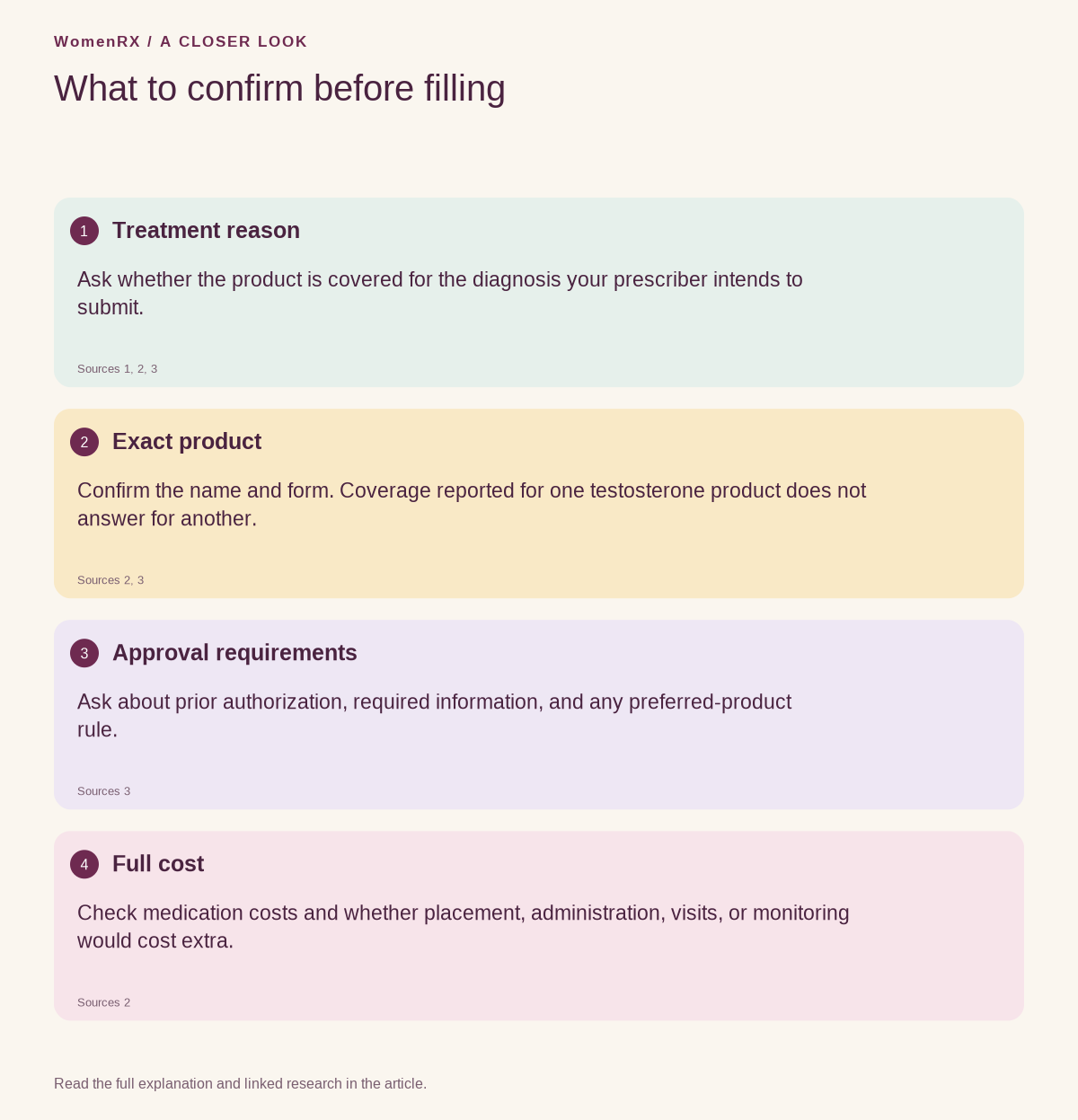
Treatment reason: Ask whether the product is covered for the diagnosis your prescriber intends to submit.123
Exact product: Confirm the name and form. Coverage reported for one testosterone product does not answer for another.23
Approval requirements: Ask about prior authorization, required information, and any preferred-product rule.3
Full cost: Check medication costs and whether placement, administration, visits, or monitoring would cost extra.2
Read the figure as text
Have the proposed diagnosis and exact product name ready, then check these details with your plan.- Treatment reason: Ask whether the product is covered for the diagnosis your prescriber intends to submit.123
- Exact product: Confirm the name and form. Coverage reported for one testosterone product does not answer for another.23
- Approval requirements: Ask about prior authorization, required information, and any preferred-product rule.3
- Full cost: Check medication costs and whether placement, administration, visits, or monitoring would cost extra.2
More questions, answered
Does insurance approval mean testosterone is right for my symptoms?
No. Approval answers a payment question, not whether the proposed treatment fits your symptoms. If testosterone is being discussed for low desire or a menopause-related concern, ask your clinician what benefit they expect and how they’ll assess whether it’s helping.
Sources you can check
- Health Insurance: MedlinePlusAccessed 2026-09-25Return to first citation
- Easing the burden: exploring the role of long-acting testosterone formulations in gender-affirming care.Hudda R, Nguyen V, Iyengar R, Pfeil A, Hsieh TM, Blumenthal J. · Frontiers in public health · 2026Return to first citation
- Treatment of Symptomatic Male Hypogonadism with New Oral Testosterone Therapies: A Comparative Review of Jatenzo, Tlando, and Kyzatrex.Rosen SH, Asanad K. · Medicines (Basel, Switzerland) · 2025Return to first citation
- Practice Comparison and Cost Analysis of Direct-to-Consumer Telemedicine Platforms Offering Testosterone Therapy.Jesse E, Sellke N, Rivero MJ, Muncey W, Ghayda RA, Loeb A, Thirumavalavan N. · The journal of sexual medicine · 2022Return to first citation