Menopause HRT Side Effects: What Needs Attention?
Headaches and spotting can happen after starting menopause hormone therapy, but the timing, treatment type, and symptom itself determine what to do next.
Mild headaches, breast tenderness, nausea, or spotting can occur after starting menopause hormone therapy and may improve with time. Severe or persistent effects deserve a conversation with your prescriber. Heavy or later unexpected bleeding needs assessment; one-sided leg pain or swelling needs prompt attention. Sudden trouble speaking, a one-sided facial droop, or possible heart-attack chest pain calls for emergency care.2371
First, look at what changed
A symptom that appears after you start or change hormone therapy is worth noticing, but timing alone doesn’t prove the medicine caused it. Headaches, for example, can be an HRT side effect and can also occur around menopause. Many people have no side effects or only mild ones, and early effects often improve. If an effect is severe, keeps bothering you, or continues beyond three months, contact your prescriber rather than trying to push through it.3
The most useful distinction is not simply “normal or dangerous.” Ask whether the symptom is mild and settling, whether it follows an expected bleeding pattern for your regimen, or whether it could signal a problem that shouldn’t wait. Your own product information matters here: side effects and instructions differ among tablets, patches, gels, and combination products.37
Match the symptom to the hormones you take
Estrogen can cause headaches; its other possible effects include nausea and, with a patch, gel, or spray, irritation where it’s applied. If you also take a progestogen, that component may account for some effects. Combined therapy can bring effects associated with either hormone. Checking the information for both products is more useful than assuming every new symptom comes from estrogen.37
For a concrete example of why the product matters, the US information for one oral estradiol-and-progesterone capsule lists breast tenderness, headache, nausea, vaginal bleeding or discharge, and pelvic pain among possible common effects. That list describes that product, not every estrogen-only or combined regimen.2 The progestogen in your prescription might be progesterone or a different progestin. Tell your prescriber which one you use, rather than describing it only as “HRT.”
If a headache is severe or lasts more than a week, or nausea lasts more than a week, contact your prescriber. The same goes for a breast change or lump, rather than assuming it’s ordinary tenderness. A clinician may consider whether the dose, hormone, or route of treatment needs changing; don’t change the regimen on your own to test a theory.567
Bleeding needs its own timeline
Spotting in the first few months after starting HRT is common and often settles within six months. What counts as expected also depends on the schedule. With sequential combined therapy, a withdrawal bleed at the end of each course of progestogen can be part of the regimen. With continuous combined therapy, irregular spotting can occur during the first four to six months.3
That does not make all bleeding something to wait out. Contact your prescriber about heavy bleeding or unexpected bleeding after six months of HRT. If you’ve had a hysterectomy, report any vaginal bleeding. These are reasons to find out what’s happening, not reasons to assume HRT is the cause.67
When you describe bleeding, mention whether it’s spotting or a heavier flow, when it began, and where it falls in your treatment schedule. For example, bleeding at the end of a planned progestogen course gives your prescriber different information from bleeding that starts unexpectedly after months without it.3
Some symptoms should not wait for a routine HRT review
Pain, redness, or swelling in one leg, often in the calf, needs prompt medical advice because it could be a deep vein thrombosis, or blood clot.7 Sudden difficulty speaking, a drooping face on one side, or difficulty moving an arm or leg calls for emergency care because these can be signs of stroke.7 Chest pain that feels crushing or squeezing, sometimes spreading to the arm, neck, or jaw, can be a heart-attack symptom and also needs emergency care.1
These warnings do not mean a person taking HRT should expect a clot, stroke, or heart attack. They mean a potentially serious symptom should be assessed on its own merits, rather than explained away as an adjustment to hormones. Research on longer-term risks also cannot give one universal risk estimate for every prescription: an umbrella review found that results can vary by hormone combination and that the reviewed evidence could not adequately account for formulation, route, duration, or age when treatment began.4
For a non-emergency effect, have the exact product name, when you started or changed it, and the symptom’s timing to hand when you contact your prescriber. That short account can help distinguish an early effect that’s easing from one that’s worsening, persisting, or following a bleeding pattern that needs assessment.37
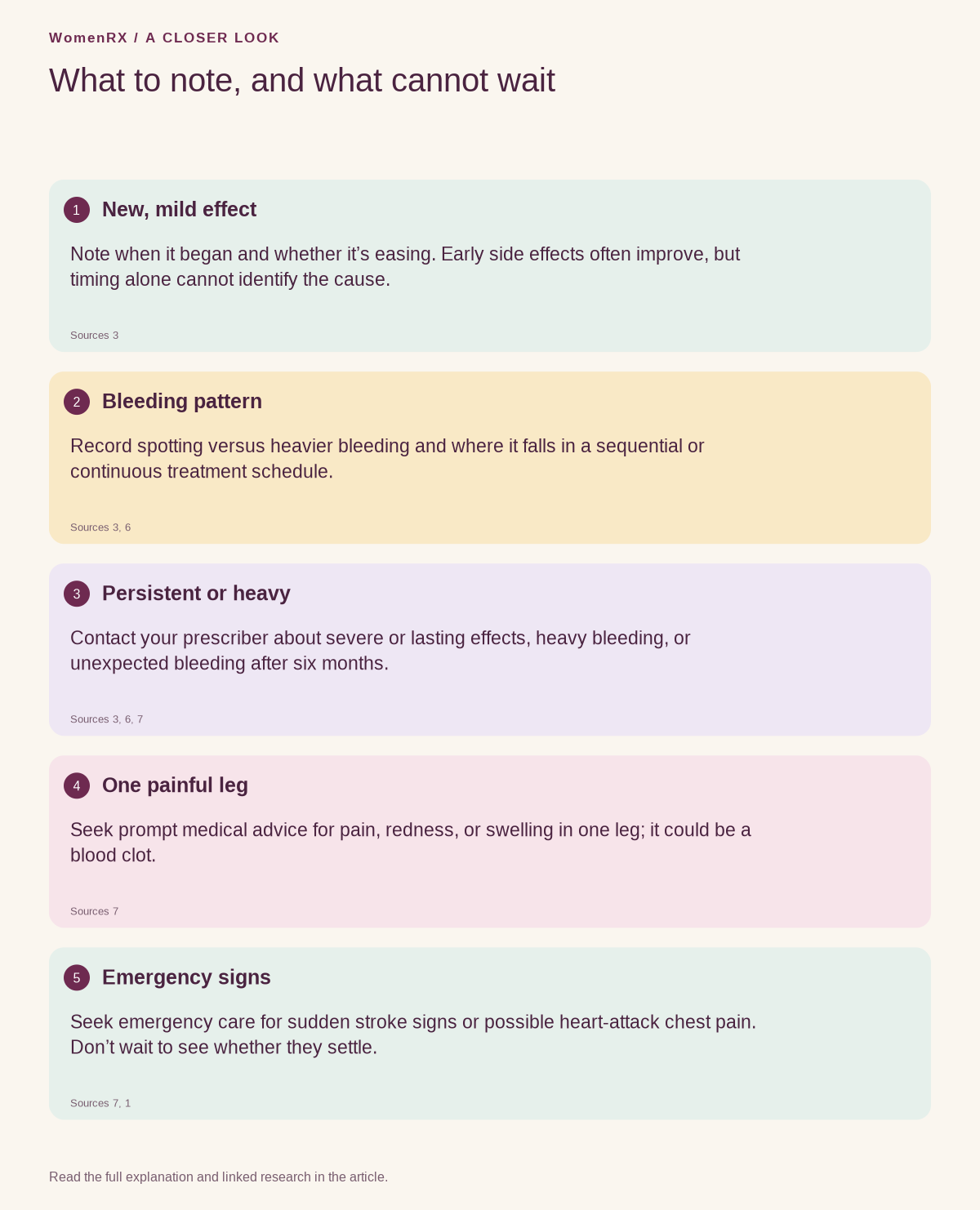
What to note, and what cannot wait
New, mild effect: Note when it began and whether it’s easing. Early side effects often improve, but timing alone cannot identify the cause.3
Bleeding pattern: Record spotting versus heavier bleeding and where it falls in a sequential or continuous treatment schedule.36
Persistent or heavy: Contact your prescriber about severe or lasting effects, heavy bleeding, or unexpected bleeding after six months.367
One painful leg: Seek prompt medical advice for pain, redness, or swelling in one leg; it could be a blood clot.7
Emergency signs: Seek emergency care for sudden stroke signs or possible heart-attack chest pain. Don’t wait to see whether they settle.71
Read the figure as text
Use the symptom and its timing to decide what information to share and how quickly to seek help; this is not a diagnostic test.- New, mild effect: Note when it began and whether it’s easing. Early side effects often improve, but timing alone cannot identify the cause.3
- Bleeding pattern: Record spotting versus heavier bleeding and where it falls in a sequential or continuous treatment schedule.36
- Persistent or heavy: Contact your prescriber about severe or lasting effects, heavy bleeding, or unexpected bleeding after six months.367
- One painful leg: Seek prompt medical advice for pain, redness, or swelling in one leg; it could be a blood clot.7
- Emergency signs: Seek emergency care for sudden stroke signs or possible heart-attack chest pain. Don’t wait to see whether they settle.71
More questions, answered
Does spotting mean I should stop HRT?
Not necessarily. Early spotting can occur, and expected bleeding differs between sequential and continuous combined regimens. Heavy bleeding, bleeding that starts unexpectedly after six months, or any vaginal bleeding after a hysterectomy should be discussed with your prescriber. Check your product instructions before making any change.367
Sources you can check
- Heart attack - NHSAccessed 2026-09-25Return to first citation
- BIJUVA (ESTRADIOL AND PROGESTERONE) CAPSULE [MAYNE PHARMA] | US prescribing information and patient instructionsAccessed 2026-09-25Return to first citation
- Side effects of hormone replacement therapy (HRT) - NHSAccessed 2026-09-25Return to first citation
- Menopausal hormone therapy and women's health: An umbrella review.Zhang GQ, Chen JL, Luo Y, Mathur MB, Anagnostis P, Nurmatov U, Talibov M, Zhang J, Hawrylowicz CM, Lumsden MA, Critchley H, Sheikh A, Lundbäck B, Lässer C, Kankaanranta H, Lee SH, ... · PLoS medicine · 2021Return to first citation
- Side effects of continuous combined HRT - NHSAccessed 2026-09-25Return to first citation
- Side effects of sequential combined hormone replacement therapy (HRT) - NHSAccessed 2026-09-25Return to first citation
- Side effects of oestrogen tablets, patches, gel and spray - NHSAccessed 2026-09-25Return to first citation