Estrogen Patch Side Effects: What Needs Attention?
Skin irritation, breast tenderness, headaches, and spotting can happen after starting a patch, but some symptoms need a faster response.
An estrogen patch can cause skin irritation, headache, breast tenderness, nausea, or spotting. Contact your prescriber if a headache is severe or lasts longer than a week, or if other effects are severe or persist. Bleeding after menopause needs assessment, even if you’ve recently started treatment. Seek prompt advice for one-sided leg symptoms and emergency help for chest pain with breathlessness or stroke-like symptoms.6317
First, check where the symptom is happening
An itchy or red patch-shaped area points to an application-site reaction rather than a symptom affecting your whole body. Skin irritation and trouble keeping a patch attached are particular drawbacks of transdermal treatment. If irritation keeps happening, or an itchy rash is limited to the application site, contact your prescriber about the formulation rather than simply putting up with it.46
Check whether the patch is still firmly attached. For the next application, the instructions for your specific product matter: estradiol patches generally go on clean, dry skin without lotion or powder, but approved sites and how well a patch stays on during bathing can vary by brand. If it lifts or falls off, check your product’s directions or ask your pharmacist what to do rather than adding extra patches. If you also take a progestogen, check its information too: a new symptom may be related to either medicine.76
Headache, breast tenderness, and nausea
Headaches, breast pain or tenderness, and nausea are recognized effects of estrogen treatment. They often improve after starting treatment, but “common” doesn’t mean you have to endure an effect that is severe or interfering with your day. Contact your prescriber if a headache is severe or lasts longer than a week. For other severe side effects, or effects that continue beyond three months, contact your prescriber too. A change in the type or dose of hormone therapy may be worth discussing.63
A symptom can have more than one explanation. For example, breast tenderness after starting a patch may be a treatment effect, while a new breast lump or other breast change calls for a separate conversation with your clinician. And if your regimen includes a progestogen, it can also contribute to side effects, including changes in bleeding.63
The patch delivers systemic estrogen through the skin. Evidence reviewed in menopausal hormone therapy research suggests transdermal estradiol has a lower venous blood-clot risk than oral estrogen, but that comparison is not a reason to dismiss a serious new symptom as a routine patch effect. Much of the route comparison comes from observational research, while risks also depend on the person and the full hormone regimen.54
Bleeding needs its own decision
Spotting can occur in the first months of hormone therapy. The pattern also depends on the regimen: treatment that includes a progestogen for part of the month can produce a withdrawal bleed, while irregular spotting can occur early with continuous combined treatment. Tell your prescriber about new bleeding so they can interpret it in the context of your regimen; contact them sooner if it becomes heavier or changes after you’ve been on treatment for a few months.3
If you’ve gone more than a year without a period and then bleed, arrange a clinical assessment, even if it happens only once or soon after you start a patch. Hormone therapy is one possible cause, but it shouldn’t be assumed to be the cause. Postmenopausal bleeding can also come from tissue thinning, polyps, or changes in the uterine lining that need evaluation.1
If you have a uterus, check that you understand whether a progestogen is part of your plan. Systemic estrogen used without one increases the risk of changes to the uterine lining; adding a progestogen reduces the risk of endometrial hyperplasia. That distinction matters when discussing both your regimen and any bleeding.24
Symptoms that need prompt or emergency help
Get prompt medical advice for pain, tenderness, redness, or swelling in one leg, particularly the calf. These can be signs of a deep vein blood clot. A new breast lump or nipple change also needs a clinical conversation rather than being written off as ordinary tenderness.67
Seek emergency help for chest pain with breathlessness, sudden trouble speaking, a drooping face, or difficulty moving an arm or leg. Sudden swelling of the lips, tongue, or throat with trouble breathing can signal a serious allergic reaction and also needs emergency help. These symptoms need attention whether or not the patch is responsible.67
A sudden, severe headache is different from a headache that began when you started treatment. Seek immediate medical advice for a sudden, severe headache, especially if it comes with vision changes, weakness, or trouble speaking.7
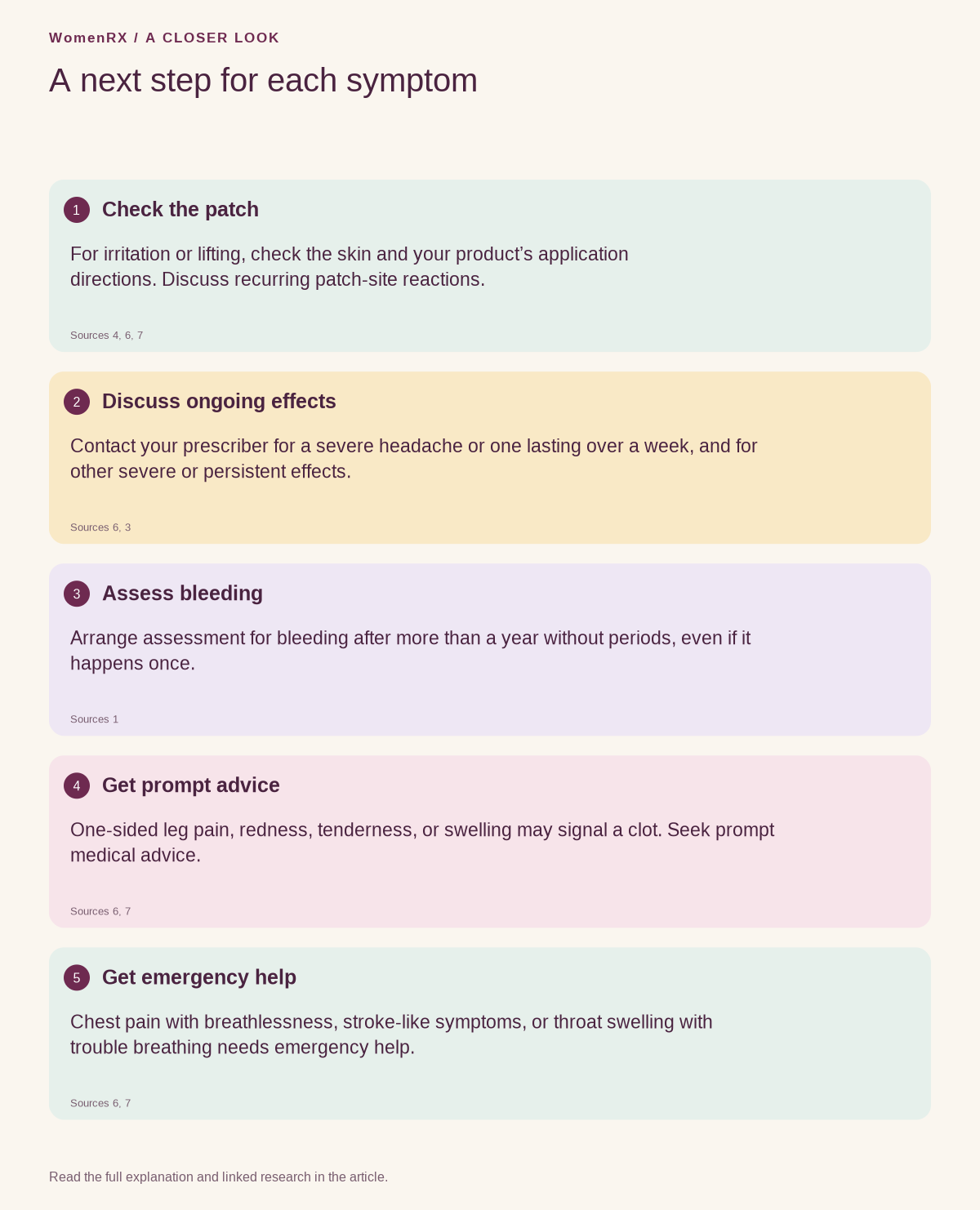
A next step for each symptom
Check the patch: For irritation or lifting, check the skin and your product’s application directions. Discuss recurring patch-site reactions.467
Discuss ongoing effects: Contact your prescriber for a severe headache or one lasting over a week, and for other severe or persistent effects.63
Assess bleeding: Arrange assessment for bleeding after more than a year without periods, even if it happens once.1
Get prompt advice: One-sided leg pain, redness, tenderness, or swelling may signal a clot. Seek prompt medical advice.67
Get emergency help: Chest pain with breathlessness, stroke-like symptoms, or throat swelling with trouble breathing needs emergency help.67
Read the figure as text
Match what’s happening to the appropriate response. The patch site, bleeding, and sudden whole-body symptoms call for different decisions.- Check the patch: For irritation or lifting, check the skin and your product’s application directions. Discuss recurring patch-site reactions.467
- Discuss ongoing effects: Contact your prescriber for a severe headache or one lasting over a week, and for other severe or persistent effects.63
- Assess bleeding: Arrange assessment for bleeding after more than a year without periods, even if it happens once.1
- Get prompt advice: One-sided leg pain, redness, tenderness, or swelling may signal a clot. Seek prompt medical advice.67
- Get emergency help: Chest pain with breathlessness, stroke-like symptoms, or throat swelling with trouble breathing needs emergency help.67
More questions, answered
Does a skin reaction mean I’m allergic to estrogen?
Not necessarily. Local irritation is a known issue with patches. If an itchy reaction at the patch site keeps recurring or the patch is hard to tolerate, tell your prescriber; another formulation may make more sense.46
Sources you can check
- Postmenopausal bleeding - NHSAccessed 2026-09-25Return to first citation
- CLIMARA PRO (ESTRADIOL AND LEVONORGESTREL) PATCH [BAYER HEALTHCARE PHARMACEUTICALS INC.] | US prescribing information and patient instructionsAccessed 2026-09-25Return to first citation
- Side effects of hormone replacement therapy (HRT) - NHSAccessed 2026-09-25Return to first citation
- Menopausal Hormone Therapy-Risks, Benefits and Emerging Options: A Narrative Review.Arnautu AM, Nimigean VR, Nacea-Radu CA, Tilici DM, Paun DL. · International journal of molecular sciences · 2025Return to first citation
- Menopausal hormone therapy and venous thromboembolism.Bińkowska M. · Przeglad menopauzalny = Menopause review · 2014Return to first citation
- Side effects of oestrogen tablets, patches, gel and spray - NHSAccessed 2026-09-25Return to first citation
- Estradiol Transdermal Patch: MedlinePlus Drug InformationAccessed 2026-09-25Return to first citation