Is an Apple Cider Vinegar Supplement Worth Trying?
The strongest reason to consider one comes from a narrow PCOS trial, while many other claims rely on studies of liquid vinegar or different goals.
It depends on your goal and the product. A 12-week trial found metabolic improvements when women with PCOS, insulin resistance, and metabolic syndrome added ACV capsules to metformin. A separate diabetes trial tested liquid vinegar, not supplements. Neither result tells you whether a retail capsule or gummy will help you, and neither establishes how it fits with your medications or a pregnancy. 1 2
First, match the claim to the form tested
“Apple cider vinegar” on a supplement label can sound like the same intervention used in every study. It isn’t. A trial in women with PCOS tested capsules against placebo while participants continued metformin. A trial in adults with type 2 diabetes tested liquid vinegar alongside diet advice. A result for one form, population, and outcome doesn’t establish a result for a different product on a store shelf. 1 2
That distinction gives you a useful first filter: What change are you hoping to see, and was that change studied with a product like the one you’re considering?
For PCOS-related metabolic concerns, there’s a specific signal
In a randomized 12-week trial, 94 women with PCOS, insulin resistance, and metabolic syndrome received either ACV capsules or placebo alongside metformin. Metabolic syndrome resolved in 74.5% of the ACV group versus 40.4% of the placebo group. The researchers also reported improvements in measures of insulin resistance. This is evidence about an add-on in women meeting all three study criteria, not evidence that ACV treats every aspect of PCOS or can replace metformin. 1
The same trial reported a greater reduction in BMI in the ACV group than in the placebo group. That finding deserves mention if weight is your goal, but it came from one 12-week add-on study in a narrowly defined group. It doesn’t establish dependable weight loss from retail ACV supplements for women generally. 1
If this sounds close to your situation, the useful question isn’t simply “Should I take ACV?” It’s “Would the specific product I’m considering be meaningfully comparable to what was tested, and what outcome would we use to judge whether adding it makes sense?” The trial cannot answer that product-level question for you. 1
For blood sugar, don’t turn a vinegar result into a capsule claim
An eight-week randomized trial in adults with type 2 diabetes compared liquid ACV plus healthy-diet advice with healthy-diet advice alone. It reported a between-group difference in HbA1c after eight weeks, along with changes in some other blood-sugar and lipid measures. Of the 73 participants, 48 were women, but the reported outcomes were not separated by sex. The study was open-label and did not test capsules or gummies. 2
So if your aim is blood-sugar management, this trial is a reason to ask a focused question, not a reason to swap prescribed treatment for a supplement. The PCOS trial likewise studied capsules alongside metformin, not instead of it. 1 2
For exercise or broad wellness, the case is weaker
In a randomized crossover trial involving 14 healthy participants, ACV did not significantly improve the main exercise-performance comparison against a commercial sports drink. That small study offers little reason to choose an ACV supplement for endurance. It also cannot settle unrelated claims about feeling more energetic or improving general health. 3
A product may advertise several benefits at once. Check each one separately: a finding about metabolic measures in a particular clinical group does not demonstrate an effect on exercise performance or everyday energy. 1 2 3
Before buying, make the safety conversation specific
These trials don’t establish a complete adverse-effect profile for concentrated retail products or identify how a particular supplement might fit with every medication. That’s a gap to address honestly, not a claim that a specific interaction has been proven. The capsule trial involved women taking metformin, but it was not a test of every ACV product alongside every blood-sugar treatment. 1 2
If you use medication to manage blood sugar, bring the exact product label and your medication list to the clinician who manages that treatment. Ask: Does this form and amount resemble anything studied? Could adding it affect how we assess my blood-sugar control? Would you want any change in monitoring? What unwanted effects should prompt me to stop taking it and check in? Those questions are more useful than asking whether ACV is “safe” in the abstract. 1 2
Check the label for the form, serving size, listed ACV or acetic-acid amount, and other ingredients, then ask about the whole product, not just vinegar. If you’re pregnant or breastfeeding, seek individualized advice before trying a concentrated product: the studies above do not establish safety in either situation. 1 2
The decision is clearest when the goal is specific. The PCOS capsule finding may be worth discussing if you resemble the women studied and already receive care for those metabolic concerns. Liquid-vinegar findings in type 2 diabetes are not proof for a supplement. For exercise performance or a vague promise of wellness, these trials offer little reason to buy one. 1 2 3
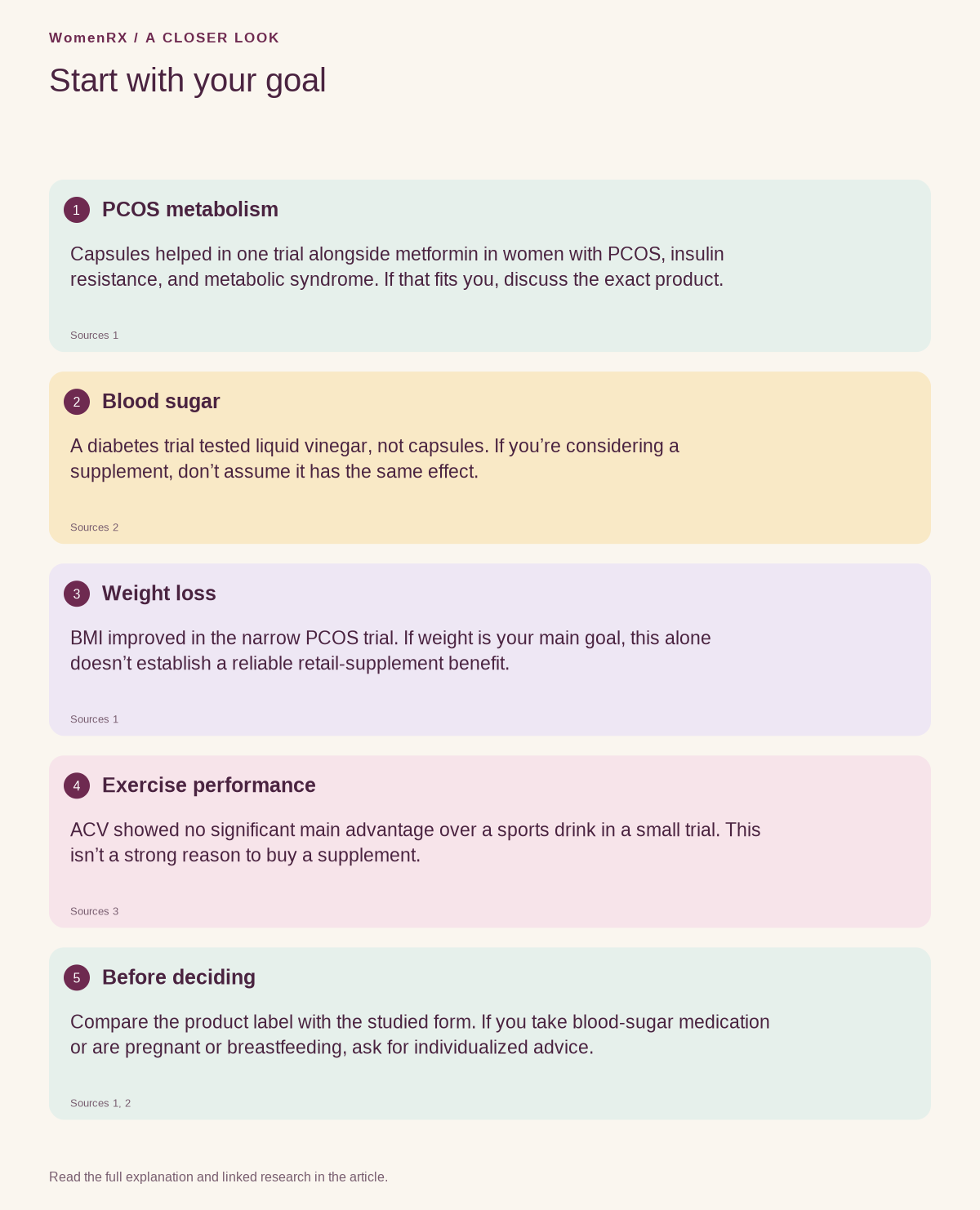
Start with your goal
PCOS metabolism: Capsules helped in one trial alongside metformin in women with PCOS, insulin resistance, and metabolic syndrome. If that fits you, discuss the exact product.1
Blood sugar: A diabetes trial tested liquid vinegar, not capsules. If you’re considering a supplement, don’t assume it has the same effect.2
Weight loss: BMI improved in the narrow PCOS trial. If weight is your main goal, this alone doesn’t establish a reliable retail-supplement benefit.1
Exercise performance: ACV showed no significant main advantage over a sports drink in a small trial. This isn’t a strong reason to buy a supplement.3
Before deciding: Compare the product label with the studied form. If you take blood-sugar medication or are pregnant or breastfeeding, ask for individualized advice.12
Read the figure as text
Follow the branch that fits your goal, then check whether the studied form and your circumstances match before deciding.- PCOS metabolism: Capsules helped in one trial alongside metformin in women with PCOS, insulin resistance, and metabolic syndrome. If that fits you, discuss the exact product.1
- Blood sugar: A diabetes trial tested liquid vinegar, not capsules. If you’re considering a supplement, don’t assume it has the same effect.2
- Weight loss: BMI improved in the narrow PCOS trial. If weight is your main goal, this alone doesn’t establish a reliable retail-supplement benefit.1
- Exercise performance: ACV showed no significant main advantage over a sports drink in a small trial. This isn’t a strong reason to buy a supplement.3
- Before deciding: Compare the product label with the studied form. If you take blood-sugar medication or are pregnant or breastfeeding, ask for individualized advice.12
More questions, answered
Does the PCOS study support stopping metformin if I try ACV?
No. Everyone in that trial was receiving metformin; researchers tested ACV capsules as an addition, not a replacement. 1
Do diabetes study results apply specifically to women?
The liquid-vinegar trial included 48 women among 73 adults, but its reported outcomes weren’t separated for women and men. 2
Sources you can check
- Adjunctive effects of apple cider vinegar on metabolic syndrome and insulin resistance in polycystic ovary syndrome patients receiving metformin: a randomized clinical trial.Najafi A, Jahanian Sadatmahalleh S, Moini A, Nasiri M, Hajimoosayi F. · Scientific reports · 2026Return to first citation
- The improvement effect of apple cider vinegar as a functional food on anthropometric indices, blood glucose and lipid profile in diabetic patients: a randomized controlled clinical trial.Jafarirad S, Elahi MR, Mansoori A, Khanzadeh A, Haghighizadeh MH. · Frontiers in clinical diabetes and healthcare · 2023Return to first citation
- The ergogenic activity of cider vinegar: A randomized cross-over, double-blind, clinical trial.Chiu HF, Chiang M, Liao HJ, Shen YC, Venkatakrishnan K, Cheng IS, Wang CK. · Sports medicine and health science · 2020Return to first citation