Does Apple Cider Vinegar Cause Lasting Weight Loss?
A review found short-term differences in weight measures, but it doesn’t show whether those changes last.
A 2025 review of 10 randomized trials involving 789 adults found pooled results favoring apple cider vinegar for body weight, BMI, and waist circumference. But the results are standardized effects, not pounds or inches lost, and they don’t establish whether changes persist after vinegar use ends. The reported findings also don’t show whether effects differ for women or across life stages. 2
What the pooled results say
A 2025 systematic review and meta-analysis combined 10 randomized controlled trials involving 789 adults. The trials studied apple cider vinegar for at least four weeks. In the pooled analysis, results favored vinegar for body weight, body mass index (BMI), and waist circumference. 2
The estimates were standardized mean differences: −0.39 for weight, −0.65 for BMI, and −0.34 for waist circumference. These aren’t pounds, BMI points, or inches. They show the direction and standardized size of the pooled differences, but they don’t tell you how much weight a person could expect to lose. 2
The review found no significant effects on its other analyzed body-composition measures. That distinction matters: a change in weight or waist measurement doesn’t, by itself, tell you what changed in body composition. Body weight includes muscle, bone, fat, and water. 12
Why the size and duration matter
A statistically significant pooled result says that the overall comparison favored vinegar in these studies. It doesn’t automatically tell you whether the difference was large enough to matter in everyday life. Because the review reports standardized results rather than a typical change in pounds or inches, the estimates can’t be translated directly into an expected result for you. 2
The trials also didn’t all point with equal consistency in the same direction. The review reported variation between studies, especially for BMI. Its weight and BMI findings remained when researchers excluded studies judged to have a high risk of bias. That supports a short-term signal, while the variation still makes it harder to know how consistent the result would be across people and study settings. 2
A subgroup analysis suggested differences favoring vinegar in studies lasting up to 12 weeks. That describes measurements during an intervention, not what happened afterward. The reported findings don’t establish whether participants kept any changes once vinegar use stopped. 2
This is the central limit if you’re considering vinegar for weight management: evidence of a difference during a study is not evidence that the difference lasts. To judge a claim of lasting weight loss, you’d want to know both the size of the change in familiar units and whether researchers measured participants after the intervention ended. The review’s reported results don’t answer those questions. 2
What the findings say about women
The review reports pooled results for adults, but its reported findings don’t give sex-specific estimates or results for pregnancy, postpartum, perimenopause, or postmenopause. So they can’t show whether the measured effects differ for women, or across those life stages. 2
The most accurate takeaway is narrow but useful: randomized trials show a pooled short-term difference in several weight-related measurements. They don’t establish a predictable amount of weight loss in pounds, a change in body composition, or lasting results after vinegar use ends. 12
What the weight trials can show
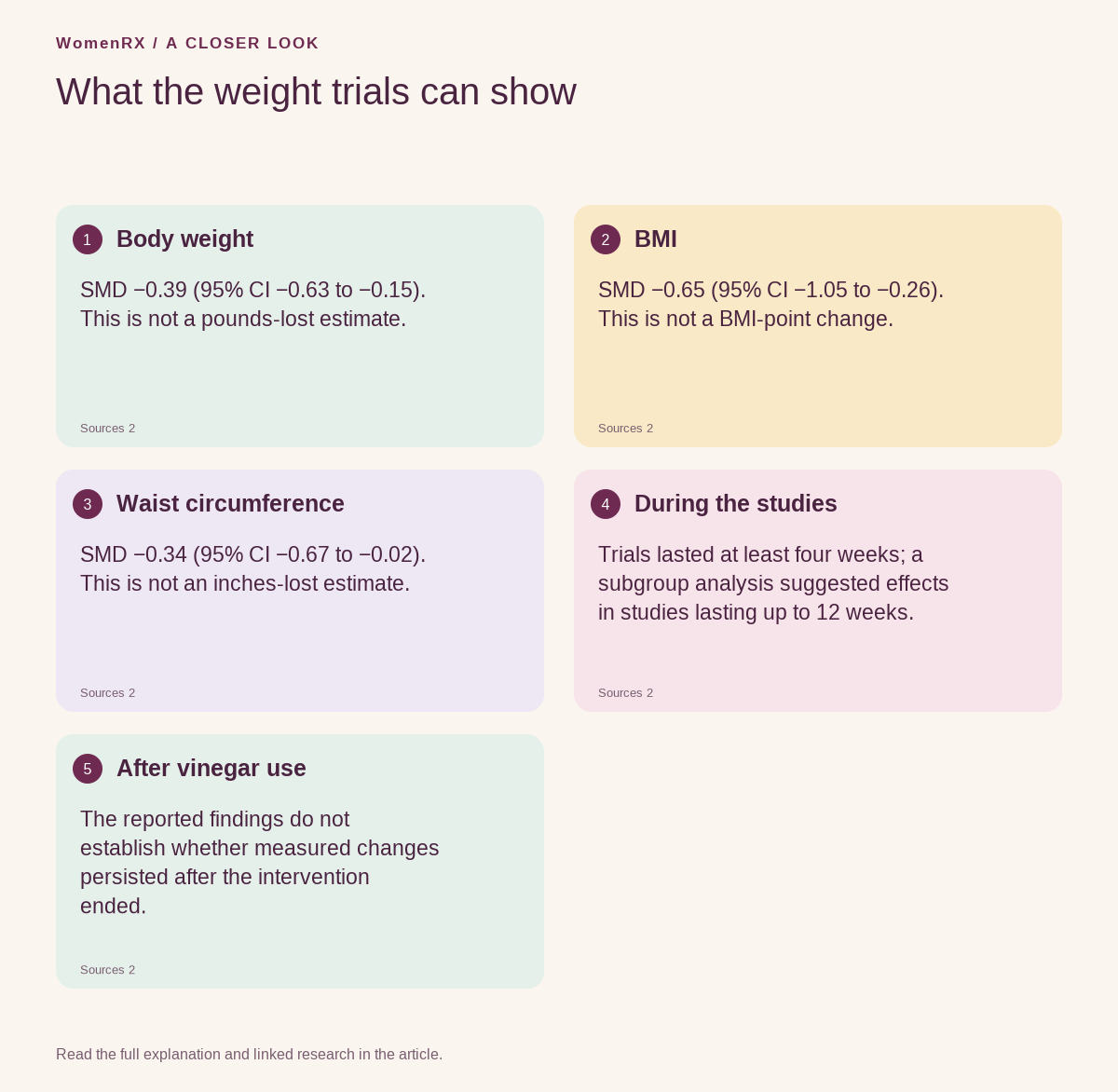
Body weight: SMD −0.39 (95% CI −0.63 to −0.15). This is not a pounds-lost estimate.2
BMI: SMD −0.65 (95% CI −1.05 to −0.26). This is not a BMI-point change.2
Waist circumference: SMD −0.34 (95% CI −0.67 to −0.02). This is not an inches-lost estimate.2
During the studies: Trials lasted at least four weeks; a subgroup analysis suggested effects in studies lasting up to 12 weeks.2
After vinegar use: The reported findings do not establish whether measured changes persisted after the intervention ended.2
Read the figure as text
The pooled results favored vinegar on three measurements, but the units and study window limit what you can conclude.- Body weight: SMD −0.39 (95% CI −0.63 to −0.15). This is not a pounds-lost estimate.2
- BMI: SMD −0.65 (95% CI −1.05 to −0.26). This is not a BMI-point change.2
- Waist circumference: SMD −0.34 (95% CI −0.67 to −0.02). This is not an inches-lost estimate.2
- During the studies: Trials lasted at least four weeks; a subgroup analysis suggested effects in studies lasting up to 12 weeks.2
- After vinegar use: The reported findings do not establish whether measured changes persisted after the intervention ended.2
More questions, answered
Does a statistically significant result mean the weight loss is substantial?
Not necessarily. The review found statistically significant pooled differences, but reported them as standardized effects rather than pounds lost. Those results don’t establish how large a typical person’s change would be. 2
Does a lower scale number show that body fat decreased?
No. Weight includes muscle, bone, fat, and water, so weight alone can’t identify which component changed. The review also found no significant effects on its other analyzed body-composition measures. 12
Sources you can check
- Body Weight: MedlinePlusAccessed 2026-09-25Return to first citation
- Effect of Apple Cider Vinegar Intake on Body Composition in Humans with Type 2 Diabetes and/or Overweight: A Systematic Review and Meta-Analysis of Randomized Controlled Trials.Castagna A, Ferro Y, Noto FR, Bruno R, Aragao Guimaraes A, Pujia C, Mazza E, Maurotti S, Montalcini T, Pujia A. · Nutrients · 2025Return to first citation