What to Discuss Before Seeking Paroxetine Online
A useful online visit should connect paroxetine to a specific treatment goal and include a plan for follow-up and medication changes.
Before discussing paroxetine online, explain your diagnosis, past treatments, other medicines, and what you want to improve. Ask about side effects, follow-up, missed doses, and any change or stopping plan. Mention pregnancy plans, pregnancy, postpartum or breastfeeding status, and menopause when relevant. 1 3 One pharmacy listed 30 generic 40 mg tablets for $6.38 on September 25, 2026, with $5.25 standard shipping extra; that isn’t a visit price. 5

Begin with the reason for treatment
Tell the prescriber what condition you’ve been diagnosed with and which symptoms you want help with. Paroxetine products shouldn’t be treated as interchangeable just because they share an ingredient: for example, the Brisdelle product label describes use for moderate to severe VMS and says that product is not approved for depression or bipolar depression. That distinction makes it worth confirming the exact product and the treatment goal during the visit. 1
You can prepare by noting what you’ve tried before, whether it helped, and any side effects that led you to stop or change treatment. Bring a current list of prescription medicines, over-the-counter products, and supplements so the prescriber can review your situation. If you’ve ever had unusually elevated or energized moods, or a history of bipolar disorder in your family, mention it. The Brisdelle label calls for bipolar-risk screening before starting that product. 1
Ask how side effects and progress will be reviewed
Side effects are easier to discuss when you name the changes you care about. The Brisdelle label notes that SSRI treatment can affect sexual function in women, including decreased libido or delayed or absent orgasm, and advises asking about sexual function before and during treatment. If that matters to you, you can ask how to tell whether a change might be medication-related and what options would be considered. 1
Make follow-up part of the plan, rather than treating the prescription as the whole visit. In one 24-week randomized trial of outpatients with moderate to severe major depression, measurement-based care used symptom ratings and treatment decisions guided by those ratings; the medication options in the study were paroxetine or mirtazapine. The study found better response and remission outcomes with measurement-based care than with standard care, but it cannot show that the same results will occur in online care or for every person taking paroxetine. 4
Useful questions include:
- What change should we look for, and when will we review it?
- How should I report side effects or worsening symptoms?
- What should I do if I miss a dose?
- If this isn’t helping, how will we decide what to change?
- If I want to stop or switch, what is the plan?
Don’t make a sudden medication change without discussing it. Abrupt discontinuation of antidepressants can cause distressing symptoms, which is one reason to ask for a plan before stopping or changing treatment. 2
Bring up pregnancy, postpartum, and menopause
Share whether you’re planning a pregnancy, are pregnant, recently gave birth, or are breastfeeding. A review comparing clinical guidelines from 12 countries found differences in recommendations for antidepressant use around pregnancy. The guidelines generally did not prefer paroxetine for a new episode of perinatal depression, while some discouraged switching an antidepressant that was already working. These findings describe a mix of international guidelines, not a single recommendation for your situation. 3
Be precise about the product when discussing pregnancy. Brisdelle’s US label says that this product is contraindicated during pregnancy; that product-specific statement shouldn’t be assumed to describe every paroxetine product or every treatment decision. If you take paroxetine and become pregnant or are planning pregnancy, discuss the risks and options with the prescriber rather than making a sudden change. 1 2
If you’re seeking treatment for moderate to severe VMS during menopause, say so directly. Brisdelle’s label describes that product for moderate to severe VMS and says it is not indicated for premenopausal women. The product’s purpose and your life stage are therefore relevant to the conversation. 1
Make the online visit a two-way decision
Before the visit, write down your diagnosis, previous treatments, current medicines, the side effects you most want to avoid, and any pregnancy or menopause-related details that apply. During the conversation, ask who will review your progress and how you’ll reach that person if the plan needs attention. A clear discussion should leave you understanding the reason for treatment, what will be monitored, and how any future change will be handled.
If you’re comparing costs, separate the medication from the visit. On September 25, 2026, Cost Plus Drugs listed 30 generic paroxetine 40 mg tablets for $6.38, with $5.25 standard shipping added at checkout; taxes and final cost vary by location. This prescription-required listing isn’t a dose recommendation or necessarily a month’s supply, and it isn’t the price of the separate Brisdelle hot-flash formulation. Ask the online service what the visit and any follow-up cost, since the tablet listing doesn’t price those services. 5
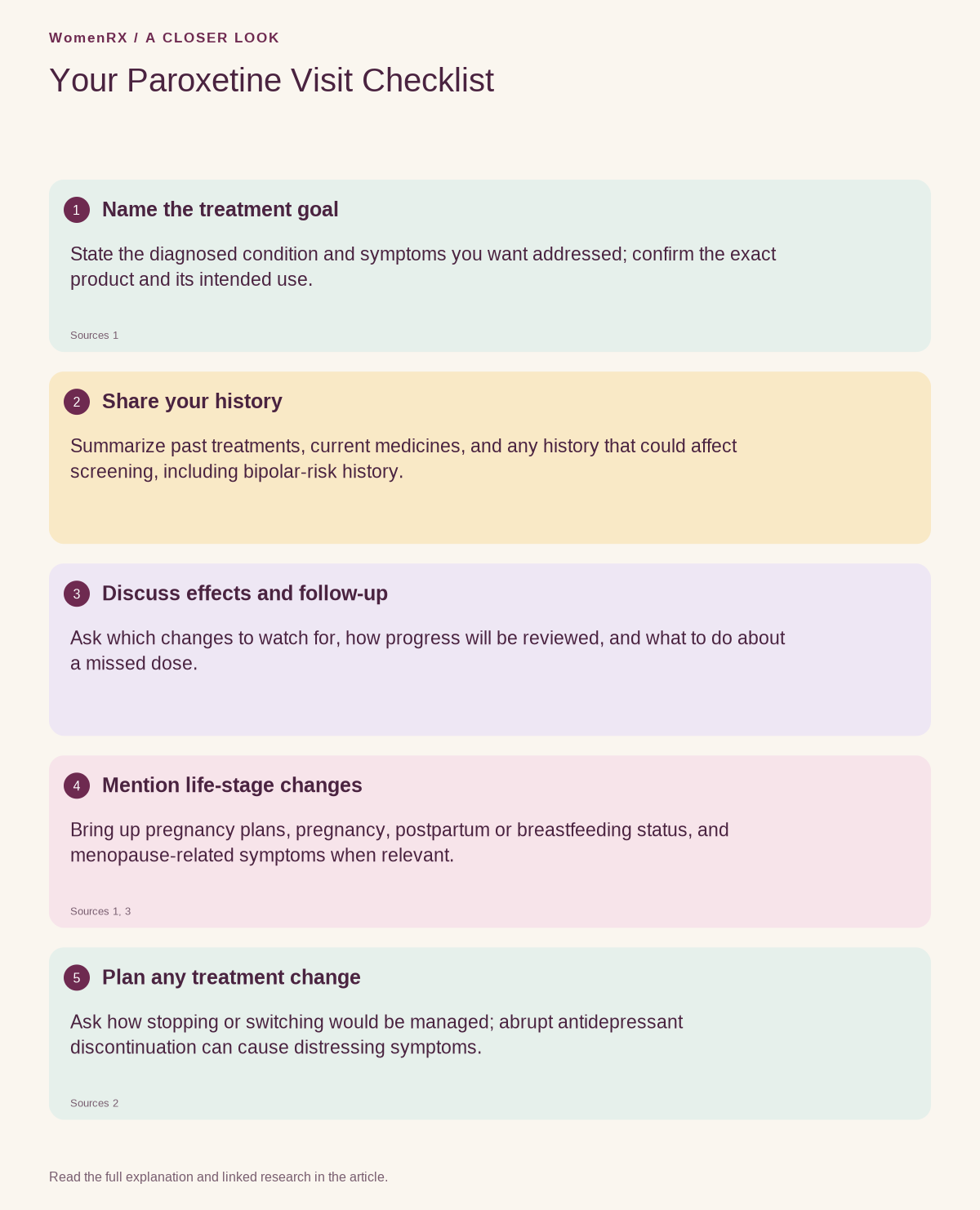
Your Paroxetine Visit Checklist
Name the treatment goal: State the diagnosed condition and symptoms you want addressed; confirm the exact product and its intended use.1
Share your history: Summarize past treatments, current medicines, and any history that could affect screening, including bipolar-risk history.
Discuss effects and follow-up: Ask which changes to watch for, how progress will be reviewed, and what to do about a missed dose.
Mention life-stage changes: Bring up pregnancy plans, pregnancy, postpartum or breastfeeding status, and menopause-related symptoms when relevant.13
Plan any treatment change: Ask how stopping or switching would be managed; abrupt antidepressant discontinuation can cause distressing symptoms.2
Read the figure as text
Use these prompts to make the conversation about a specific treatment goal, relevant personal context, and a clear follow-up plan.- Name the treatment goal: State the diagnosed condition and symptoms you want addressed; confirm the exact product and its intended use.1
- Share your history: Summarize past treatments, current medicines, and any history that could affect screening, including bipolar-risk history.
- Discuss effects and follow-up: Ask which changes to watch for, how progress will be reviewed, and what to do about a missed dose.
- Mention life-stage changes: Bring up pregnancy plans, pregnancy, postpartum or breastfeeding status, and menopause-related symptoms when relevant.13
- Plan any treatment change: Ask how stopping or switching would be managed; abrupt antidepressant discontinuation can cause distressing symptoms.2
Sources you can check
- BRISDELLE (PAROXETINE) CAPSULE [LEGACY PHARMA USA, INC.] | US prescribing information and patient instructionsAccessed 2026-09-25Return to first citation
- Genotype influences antidepressant discontinuation in a pre-emptive pharmacogenetic testing population.Baye JF, Petry NJ, Hines L, Weaver M, Reinke M, Brady H, Massmann A, Schultz A. · The pharmacogenomics journal · 2026Return to first citation
- Guidelines on treatment of perinatal depression with antidepressants: An international review.Molenaar NM, Kamperman AM, Boyce P, Bergink V. · The Australian and New Zealand journal of psychiatry · 2018Return to first citation
- Measurement-Based Care Versus Standard Care for Major Depression: A Randomized Controlled Trial With Blind Raters.Guo T, Xiang YT, Xiao L, Hu CQ, Chiu HF, Ungvari GS, Correll CU, Lai KY, Feng L, Geng Y, Feng Y, Wang G. · The American journal of psychiatry · 2015Return to first citation
- Cost Plus Drugs: Paroxetine exact package priceAccessed 2026-09-25Return to first citation