Does Tart Cherry Actually Help You Sleep?
A few small studies suggest possible sleep benefits from tart cherry juice, but results are mixed and don’t establish that powders or other products work the same way.
Tart cherry juice may improve some sleep measures for some people, but the evidence is mixed and based on small, short studies. A review found sleep improvements in three of seven included studies, while trials of tart cherry powder and a separate juice-and-powder study found no sleep benefit. There’s no clear evidence here for menstrual or menopause-related sleep problems. 2 3 4
What the human studies suggest
The short answer is that tart cherry is worth describing as a possibility, not a proven sleep aid. A 2025 systematic review found that three of seven interventional studies reported improvement in at least one sleep measure, such as sleep duration, efficiency, or time to fall asleep. The studies differed in their tart cherry products, participants, and methods, so those results don’t amount to a consistent effect across products or people. 4
One small trial studied 19 elite female field hockey players during a period of strenuous exercise. Over five days, researchers used actigraphy to track sleep. They found group-by-time differences in time in bed, wake after sleep onset, and a movement measure. But the study was very small, lasted only a few days, and involved athletes recovering from exercise. The reported results don’t tell us how large or practically meaningful the changes were, or whether they apply to everyday sleep difficulties. 1
Other results are less encouraging. In a randomized crossover study, 34 adults with overweight or obesity and sleep issues took tart cherry powder or placebo for 14 days. The group included 25 women and nine men. Researchers found no significant benefit on the measured sleep outcomes, which included sleep duration, deep and REM sleep, and questionnaire-based sleep quality and insomnia symptoms. The study did not report a separate result for women. 2
A separate 30-day study with sleep records from 44 participants compared Montmorency juice and powdered products with placebos. Sleep time and quality did not differ significantly between groups, though participants’ sleep measures increased over time in both groups. The abstract doesn’t give a women-specific result. 3
Juice, concentrate, and powder aren’t interchangeable
The most encouraging reports in the review involved juice, but that doesn’t establish that every juice, concentrate, or supplement has the same effect. In the female-athlete study, participants consumed a tart cherry juice drink. The powder trial used 500 mg of whole Montmorency cherry powder, while the 30-day study included juice and powder arms. Both powder studies found no significant sleep benefit, and the 30-day study found no between-group sleep difference overall. 1 2 3
The review also found substantial variation in the forms and amounts used across studies. So a result from one juice recipe or study schedule can’t automatically be applied to a capsule, a different powder, or a concentrate. There isn’t enough consistent head-to-head evidence here to say which preparation works best. 4
What this means if you’re considering a product
Check whether the claim you’re seeing matches the actual product and outcome studied. A study of juice in athletes after intense exercise isn’t a direct test of a powder for ongoing insomnia. And a statistically significant difference in one sleep measure doesn’t, by itself, tell you whether the change would be noticeable or worthwhile in daily life. The small studies and mixed findings leave those questions open. 1 2 4
The evidence also doesn’t establish tart cherry as a treatment for sleep disruption tied to menstrual cycles, perimenopause, or menopause. The female-athlete trial didn’t test those situations, and the other cited trial that reported the proportion of women did not provide sex-specific results. Don’t assume a finding in a mixed group, or in athletes, applies to sleep changes at another life stage. 1 2 3
For now, the fairest takeaway is modest: some juice studies report better sleep measures, but results across preparations and trials are inconsistent. If you’re comparing products, treat the preparation and study population as part of the evidence, not as details you can set aside.
What was tested, and what happened?
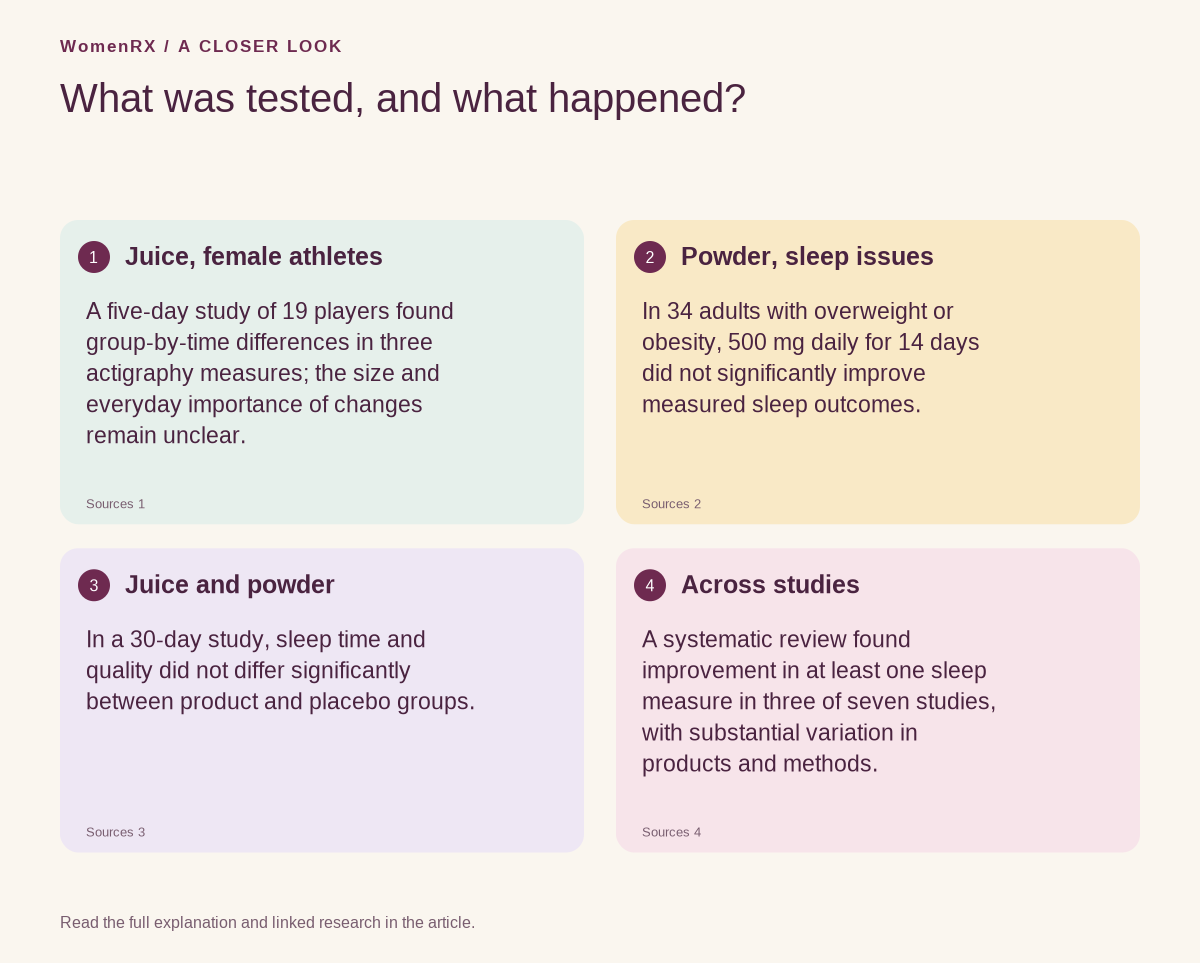
Juice, female athletes: A five-day study of 19 players found group-by-time differences in three actigraphy measures; the size and everyday importance of changes remain unclear.1
Powder, sleep issues: In 34 adults with overweight or obesity, 500 mg daily for 14 days did not significantly improve measured sleep outcomes.2
Juice and powder: In a 30-day study, sleep time and quality did not differ significantly between product and placebo groups.3
Across studies: A systematic review found improvement in at least one sleep measure in three of seven studies, with substantial variation in products and methods.4
Read the figure as text
The preparation and study setting matter: results from one small trial don’t establish that a different tart cherry product will have the same effect.- Juice, female athletes: A five-day study of 19 players found group-by-time differences in three actigraphy measures; the size and everyday importance of changes remain unclear.1
- Powder, sleep issues: In 34 adults with overweight or obesity, 500 mg daily for 14 days did not significantly improve measured sleep outcomes.2
- Juice and powder: In a 30-day study, sleep time and quality did not differ significantly between product and placebo groups.3
- Across studies: A systematic review found improvement in at least one sleep measure in three of seven studies, with substantial variation in products and methods.4
More questions, answered
Does tart cherry help with menopause-related sleep problems?
The studies summarized here don’t establish a benefit for menopause-related sleep problems. A trial in female athletes is not a study of menopausal sleep, and the mixed-sex powder study did not report results separately for women. 1 2
Sources you can check
- Effects of Short-Term Intake of Montmorency Tart Cherry Juice on Sleep Quality after Intermittent Exercise in Elite Female Field Hockey Players: A Randomized Controlled Trial.Chung J, Choi M, Lee K. · International journal of environmental research and public health · 2022Return to first citation
- Commonly Used Dose of Montmorency Tart Cherry Powder Does Not Improve Sleep or Inflammation Outcomes in Individuals with Overweight or Obesity.Tucker RM, Kim N, Gurzell E, Mathi S, Chavva S, Senthilkumar D, Bartunek O, Fenton KC, Herndon-Fenton SJ, Cardino VN, Cooney GM, Young S, Fenton JI. · Nutrients · 2024Return to first citation
- Montmorency tart cherry supplementation does not impact sleep, body composition, cellular health, or blood pressure in healthy adults.Hillman AR, Trickett O, Brodsky C, Chrismas B. · Nutrition and health · 2026Return to first citation
- The Effect of Tart Cherry on Sleep Quality and Sleep Disorders: A Systematic Review.Barforoush F, Ebrahimi S, Abdar MK, Khademi S, Morshedzadeh N. · Food science & nutrition · 2025Return to first citation