Apple Cider Vinegar: What Regular Use Can and Can’t Tell You
A little in food and a concentrated daily supplement are different uses, and neither should be treated as a proven way to manage blood sugar or weight.
Using apple cider vinegar as a food ingredient is different from taking concentrated drinks or supplements regularly. Research has reported possible blood-sugar changes in adults with type 2 diabetes, but it doesn’t establish vinegar as a diabetes treatment or prove a direct interaction with diabetes medicines. Digestive discomfort and tooth-enamel erosion with excessive intake are concerns; pregnancy and breastfeeding weren’t covered in one major review. 3 4 5
The form matters more than the label
Apple cider vinegar used to flavor food is not the same exposure as taking a concentrated drink or supplement every day. Vinegar is used as a food flavoring, while clinical studies have tested deliberate daily intake, including capsules. Those studies don’t show that culinary use and supplement use are interchangeable, or establish a universally safe amount for regular use. 3 4 5
That distinction is useful if you’re weighing a splash in a recipe against a product marketed for weight or blood-sugar benefits. The evidence for those proposed outcomes comes from specific study settings, not from a guarantee that any product or routine will have the same effect.
Blood-sugar findings aren’t a treatment plan
A 2025 review pooled seven controlled trials in people with type 2 diabetes. It reported lower fasting blood sugar and HbA1c with apple cider vinegar, but no change in HOMA-IR, a measure used to assess insulin resistance. The findings are a research signal, not proof that vinegar reliably controls glucose for an individual or can replace diabetes treatment. The review included studies with mixed or unreported participant sex, so it doesn’t establish a women-specific effect. 5
This matters if you take insulin or another medicine that can cause low blood sugar. The research summary doesn’t establish a direct apple-cider-vinegar interaction with those medicines. But because the trials reported glucose changes and some diabetes medicines can lower glucose too, it’s sensible to discuss a planned regular supplement with the person managing your diabetes care. Don’t change or stop prescribed medicine on your own. 1 2 5
What to watch for with regular use
Digestive discomfort or intolerance has been reported in some people. The clinical-trial report also notes tooth-enamel erosion as a concern with excessive intake. These reports don’t tell us exactly how likely a problem is for any one person, or establish that every product and form carries the same risk. They do argue against assuming that a concentrated product is harmless simply because vinegar is also used in food. 4
For weight, the picture also isn’t a promise. A 2025 review of 10 randomized trials, involving 789 adults, found pooled reductions in weight, BMI, and waist circumference, but the studies varied and the authors described the evidence as a possible adjunctive approach. That doesn’t show that vinegar will produce meaningful or lasting weight loss for you. 3
Pregnancy and breastfeeding are separate questions
A review of adult body-composition trials excluded pregnant and breastfeeding women. That means its findings can’t answer whether taking apple cider vinegar regularly as a supplement is safe in either situation. It also doesn’t prove harm or prove that no other research exists. A small trial in women with PCOS tested capsules alongside metformin, but that specific study doesn’t settle safety during pregnancy or breastfeeding. 3 4
If you’re pregnant or breastfeeding and considering a concentrated product, don’t assume that results from other adults apply to you. This evidence can’t resolve that question. Using vinegar as a food ingredient is a different use, but the studies summarized here don’t provide a pregnancy-specific safety assessment for regular supplemental intake. 3
A practical way to weigh the choice
If you enjoy vinegar as a food flavoring, that’s a different decision from adding a concentrated product for a health outcome. If the goal is blood-sugar management, consider the findings preliminary and bring up the product with your diabetes care team, especially if your medicines can cause low blood sugar. If the goal is weight loss, the research doesn’t justify treating vinegar as a dependable solution. If you’re pregnant or breastfeeding, the adult body-composition review doesn’t establish supplement safety. 1 3 5
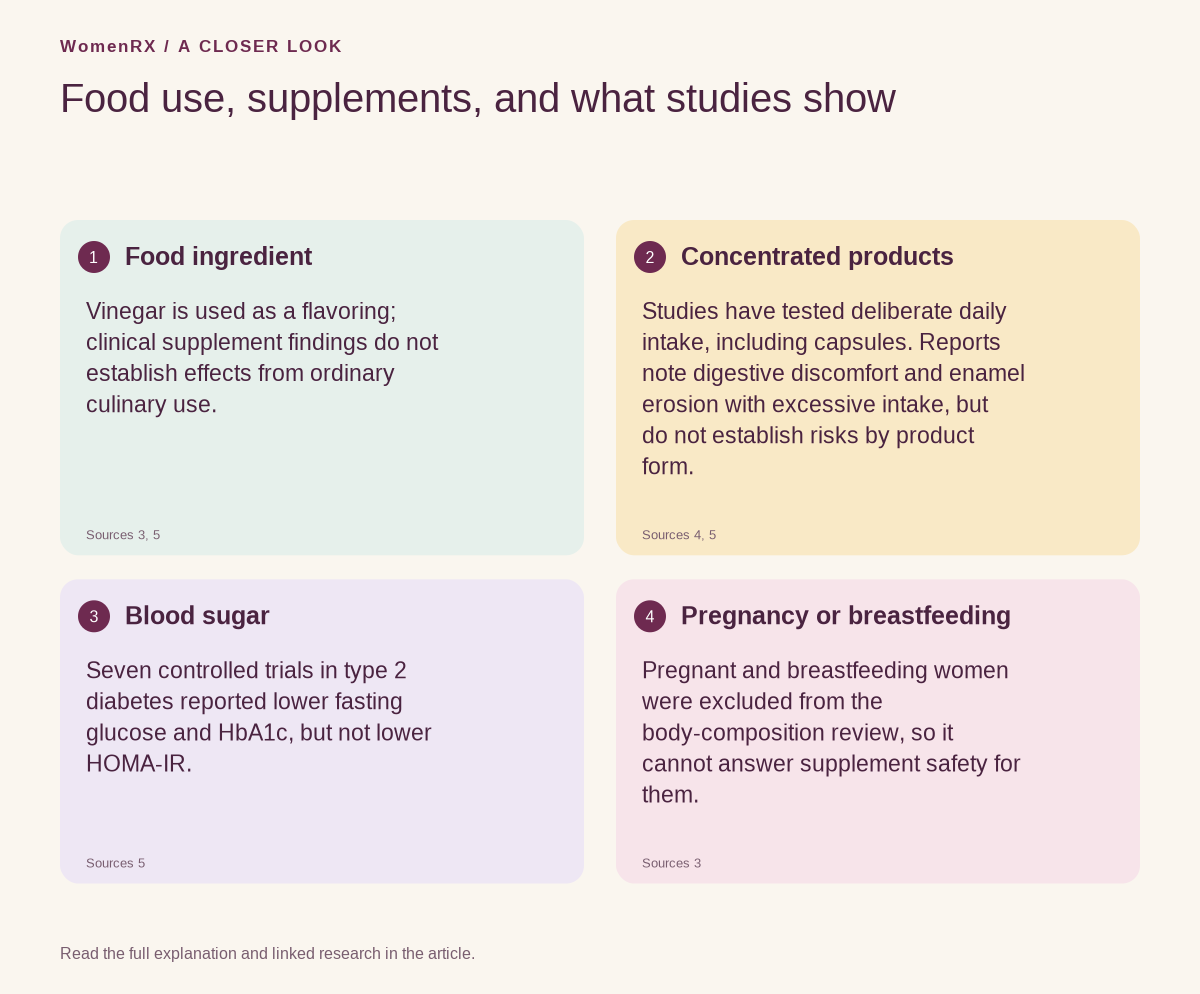
Food use, supplements, and what studies show
Food ingredient: Vinegar is used as a flavoring; clinical supplement findings do not establish effects from ordinary culinary use.35
Concentrated products: Studies have tested deliberate daily intake, including capsules. Reports note digestive discomfort and enamel erosion with excessive intake, but do not establish risks by product form.45
Blood sugar: Seven controlled trials in type 2 diabetes reported lower fasting glucose and HbA1c, but not lower HOMA-IR.5
Pregnancy or breastfeeding: Pregnant and breastfeeding women were excluded from the body-composition review, so it cannot answer supplement safety for them.3
Read the figure as text
Compare the kind of use being considered with the limits of the relevant evidence.- Food ingredient: Vinegar is used as a flavoring; clinical supplement findings do not establish effects from ordinary culinary use.35
- Concentrated products: Studies have tested deliberate daily intake, including capsules. Reports note digestive discomfort and enamel erosion with excessive intake, but do not establish risks by product form.45
- Blood sugar: Seven controlled trials in type 2 diabetes reported lower fasting glucose and HbA1c, but not lower HOMA-IR.5
- Pregnancy or breastfeeding: Pregnant and breastfeeding women were excluded from the body-composition review, so it cannot answer supplement safety for them.3
More questions, answered
Does apple cider vinegar interact with diabetes medicine?
The cited studies report glucose outcomes but don’t determine whether apple cider vinegar interacts with diabetes medicines. Some diabetes medicines can cause low blood sugar, and trials in people with type 2 diabetes reported changes in glucose measures. If you’re considering regular supplemental use, discuss it with the person managing your diabetes treatment rather than changing your medicine yourself. 1 2 5
Is apple cider vinegar supplement use established as safe during pregnancy or breastfeeding?
The adult body-composition review excluded pregnant and breastfeeding women, so it can’t establish safety for regular supplement use in either group. That evidence gap isn’t proof of harm, but findings from other adults shouldn’t be treated as an answer to this separate question. 3
Sources you can check
- Diabetes Medicine | Insulin | MedlinePlusAccessed 2026-09-25Return to first citation
- Hypoglycemia: MedlinePlusAccessed 2026-09-25Return to first citation
- Effect of Apple Cider Vinegar Intake on Body Composition in Humans with Type 2 Diabetes and/or Overweight: A Systematic Review and Meta-Analysis of Randomized Controlled Trials.Castagna A, Ferro Y, Noto FR, Bruno R, Aragao Guimaraes A, Pujia C, Mazza E, Maurotti S, Montalcini T, Pujia A. · Nutrients · 2025Return to first citation
- Adjunctive effects of apple cider vinegar on metabolic syndrome and insulin resistance in polycystic ovary syndrome patients receiving metformin: a randomized clinical trial.Najafi A, Jahanian Sadatmahalleh S, Moini A, Nasiri M, Hajimoosayi F. · Scientific reports · 2026Return to first citation
- Effects of apple cider vinegar on glycemic control and insulin sensitivity in patients with type 2 diabetes: A GRADE-assessed systematic review and dose-response meta-analysis of controlled clinical trials.Arjmandfard D, Behzadi M, Sohrabi Z, Mohammadi Sartang M. · Frontiers in nutrition · 2025Return to first citation